
Last updated: July 16, 2026
Paw Score vs Fido Score: Pet Food Quality vs Rental Screening
A Paw Score is a 1-5 rating of how good a pet food is, based on protein, ingredient quality, carbs, and fillers. Confusingly, "Paw Score" is also the name of a rental pet screening rating (formerly the Fido Score) that landlords use. This guide explains both meanings so you know which one you need.
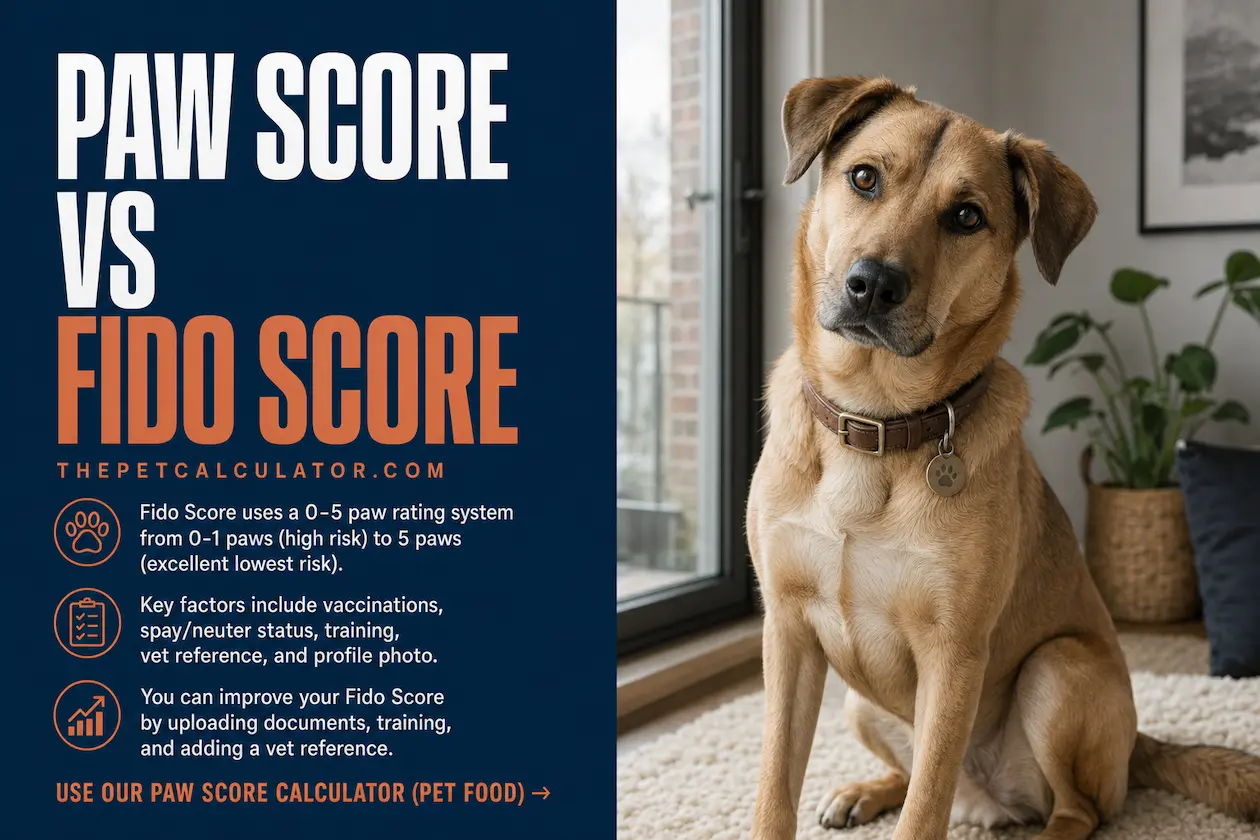
Two Different Paw Score Meanings
Understanding the confusion
Paw Score for Pet Food Quality
Our Paw Score evaluates pet food quality (1-5 paws). It assesses protein content, ingredient quality, carbohydrate levels, fillers, and additives. Use our Paw Score Calculator to rate your pet food. This is what we offer at The Pet Calculator.
Paw Score / Fido Score for Rentals
Petscreening.com's Fido Score (0-5 paws) is used by landlords for rental pet screening. It evaluates pet risk based on behavior, breed, vaccinations, and other factors. Landlords use it to set pet fees and deposits. This is a different product—we do not offer it.
Which One Do You Need?
- Evaluating pet food? Use our Paw Score Calculator for pet food quality.
- Rental application / landlord pet screening? Your landlord will direct you to Petscreening.com or a similar service. Fido Score is proprietary and cannot be calculated elsewhere.
How Is the Fido Score Calculated?
While the exact Fido Score algorithm is proprietary to Petscreening.com, the scoring system evaluates several known factors. Understanding these can help you prepare a strong pet profile for your rental application:
Factors That Help Your Score
- Vaccinations: Up-to-date rabies, DHPP/FVRCP records uploaded
- Spay/Neuter: Fixed pets score higher than intact pets
- Training: Obedience certifications or Canine Good Citizen
- Vet reference: Current veterinary relationship documented
- Profile photo: Clear, recent photo of your pet
Factors That May Lower Your Score
- Bite history: Documented bite incidents significantly lower the score
- Missing vaccinations: Outdated or missing vaccine records
- Incomplete profile: Missing information lowers confidence in the screening
- Certain breeds: Some breeds may receive a lower initial score (varies by property)
- Multiple pets: Additional pets may affect overall household score
Fido Score Scale: What Each Rating Means
The Fido Score uses a 0–5 paw rating system. Here's what each level typically indicates for your rental application:
Lowest risk. Fully vaccinated, spayed/neutered, trained, with no incidents. Most properties will accept without additional deposits.
Low risk. May be missing one factor (e.g., no training cert). Generally accepted with standard pet deposit.
Average risk. Some factors missing. Properties may require a higher pet deposit or additional pet rent.
Higher risk. Multiple missing factors or some concerns. May face higher deposits or conditional acceptance.
Significant concerns (e.g., bite history, no vaccinations). Many properties will not accept. Work with your vet to address issues and resubmit.
How to Improve Your Fido Score
If your Fido Score is lower than you'd like, here are concrete steps to raise it before your next rental application:
Step 1: Documents
Upload current vaccination records, spay/neuter certificate, and a recent clear photo. Incomplete profiles score lower.
Step 2: Training
Complete a basic obedience course or AKC Canine Good Citizen test. Upload the certificate to your profile.
Step 3: Vet Reference
Add your veterinarian's contact information. A current vet relationship signals responsible pet ownership.
Frequently Asked Questions
Paw Score vs Fido Score
What is Paw Score for pets?
"Paw Score" has two meanings: (1) Pet food quality—a 1-5 paw rating that evaluates protein, carbs, and ingredients. (2) Rental pet screening—Petscreening.com's Fido Score, a 0-5 paw rating for pet risk in apartments. Our Paw Score Calculator evaluates pet food quality.
What is Fido Score?
Fido Score is Petscreening.com's proprietary pet screening score (0-5 paws) used by landlords to assess pet risk for rental applications. It evaluates behavior, breed, vaccinations, and other factors. It is not the same as our Paw Score for pet food quality.
Where can I get a Paw Score for pet food?
Use our free Paw Score Calculator to evaluate your pet food's quality. Enter protein, carbs, ingredient quality, and other factors to get a 1-5 paw rating. We focus on pet food nutrition, not rental screening.
Where can I get a Fido Score for my rental application?
Fido Score is provided by Petscreening.com. If your landlord requires pet screening, they will direct you to their preferred service. You cannot calculate Fido Score yourself—it's a proprietary algorithm.
How is the Fido Score calculated?
Fido Score evaluates several factors: pet breed and size, vaccination status, spay/neuter status, training certifications, behavioral history, and age. Each factor contributes to a 0-5 paw rating. The exact weighting is proprietary to Petscreening.com, but keeping vaccinations current, having your pet spayed/neutered, and documenting training all help improve your score.
What is a good Fido Score for renting?
A Fido Score of 3-5 paws is generally considered favorable for rental applications. A score of 5 paws indicates the lowest risk. Scores of 0-2 paws may result in higher pet deposits, additional fees, or even rejection depending on the property's pet policy. Landlords set their own thresholds.
Can I improve my Fido Score?
Yes. To improve your Fido Score: ensure all vaccinations are current, have your pet spayed or neutered, complete a basic obedience course and upload the certificate, keep your pet's profile photo updated, and provide veterinary references. These documented responsible ownership factors can raise your score.
Is Fido Score the same as FIDO Score (pet screening)?
Yes. "Fido Score" and "FIDO Score" refer to the same Petscreening.com pet screening score. The capitalization varies, but it's the same 0-5 paw rating system used by landlords and property managers to assess pet risk in rental properties.
How is Paw Score different from Fido Score?
Paw Score (our tool) evaluates pet food quality based on protein content, carbohydrate levels, ingredient quality, and additives. Fido Score (Petscreening.com) evaluates pets themselves for rental risk. They are completely different tools for different purposes — one rates food, the other rates pets for housing.
Does Fido Score consider breed restrictions?
Fido Score itself does not ban specific breeds, but individual properties may have breed restrictions independent of the Fido Score system. The score factors in breed as one component alongside behavior, vaccinations, and other criteria. Even breed-restricted dogs can be scored.