Dachshund weight calculator

How To Use


Enter your Dachshund's sex, age, and current weight to check if they are within the healthy weight range for their stage of life.

Quick Steps

  • 1 Select your Dachshund's Sex.
  • 2 Select their Age.
  • 3 Enter their Current Weight in pounds.
  • 4 Click Calculate to see the weight assessment and full growth chart.

Dachshund Weight Calculator


Fill Out The Fields Below


About Dachshund Weight

Dachshunds (also known as sausage dogs or wiener dogs) come in two sizes: Standard and Miniature. Standard Dachshunds weigh 16–32 lbs; Miniatures weigh under 11 lbs. Their elongated spine and short legs make them uniquely susceptible to intervertebral disc disease (IVDD) — a condition dramatically worsened by excess weight. Weight management is arguably more critical for Dachshunds than almost any other breed. Even a small amount of extra weight puts significant mechanical stress on the spine.

Key Weight Characteristics

  • Two size varieties: Miniature (under 11 lbs) and Standard (16–32 lbs).
  • Dachshunds reach adult size by 12 months.
  • Their long spine and short legs make them extremely vulnerable to back problems when overweight.
  • Highly food-motivated — they will overeat readily if given the opportunity.
  • This calculator covers Standard Dachshund weight ranges; Miniature Dachshunds should weigh under 11 lbs as adults.

Body Condition Check

  • You should be able to easily feel the ribs with minimal pressure — if you cannot, your Dachshund is likely overweight.
  • From above, a waist should be clearly visible behind the rib cage.
  • From the side, the belly tuck should be moderate — a "sausage tube" shape with no tuck is a warning sign.
  • Every excess pound is proportionally much more impactful on a Dachshund than on a large breed — take weight seriously.

Standard vs Miniature vs Tweenie Dachshund: Size and Weight Differences

Dachshunds come in two officially recognised size varieties — Standard and Miniature — plus an informal third category known as the Tweenie. Understanding which category your Dachshund falls into is essential for assessing their healthy weight range.

Standard Dachshunds weigh between 16–32 lbs (7–14.5 kg) as adults. They were originally bred to hunt badgers and are the larger, more robust variety. Most Standard Dachshunds settle in the 20–25 lb range, though larger males can healthily reach 28–30 lbs depending on their frame.

Miniature Dachshunds weigh under 11 lbs (5 kg) at 12 months and older. They were bred to hunt smaller prey like rabbits. Mini Dachshunds are increasingly popular as companion dogs. A healthy adult Mini typically weighs 8–11 lbs.

Tweenie Dachshunds fall between 11–16 lbs — too heavy for Miniature classification, too light for Standard. "Tweenie" is not an official AKC designation, but it's widely used by breeders and owners. Tweenies are common when a Standard and Miniature are crossed, or when a Mini simply grows larger than expected.

All three coat types — Smooth, Wirehaired, and Longhaired — occur in both Standard and Miniature varieties. Coat type does not significantly affect weight, though Wirehaired Dachshunds may appear slightly stockier due to their coarser coat and beard.

Standard vs Tweenie vs Miniature Dachshund Size ComparisonSide-by-side silhouette comparison of all three Dachshund size varieties — Standard, Tweenie, and Miniature — showing relative body size, adult weight ranges, and daily calorie requirements.Dachshund Size Varieties: Standard vs Tweenie vs MiniatureSTANDARD16–32 lbs (7–14.5 kg)400–600 kcal/dayFully grown: 12–18 monthsTWEENIE11–16 lbs (5–7.3 kg)350–500 kcal/dayFully grown: 11–12 monthsMINIATUREUnder 11 lbs (<5 kg)250–400 kcal/dayFully grown: 10–11 monthsSilhouettes shown to scale relative to each other. All varieties share the same long-spine IVDD risk. thepetcalculator.com

All three Dachshund varieties share the same characteristic long spine and short legs — the scale differs, but the IVDD risk applies to all.

Miniature Dachshund Weight Chart by Age

This chart shows the expected weight range for Miniature Dachshunds from puppyhood to adulthood. Mini Dachshunds grow faster relative to their adult size than Standards, often reaching their full weight by 10–11 months. If your Mini Dachshund exceeds the ranges below, they may be a Tweenie or Standard — or they may simply be overweight. Consult your vet to determine which.

AgeMale (lbs)Female (lbs)
8 weeks2–3 lbs1.5–2.5 lbs
3 months3–5 lbs2.5–4.5 lbs
4 months4–6 lbs3.5–5.5 lbs
6 months6–8 lbs5–7 lbs
8 months7–10 lbs6–9 lbs
10 months8–11 lbs7–10 lbs
Adult (12+ months)8–11 lbs7–11 lbs

Note: The calculator above covers Standard Dachshund weight ranges. This table provides reference ranges specifically for Miniature Dachshunds. Individual dogs may vary — always consult your vet if you're unsure which size variety your Dachshund is.

Male vs Female Dachshund Weight Comparison

Male Standard Dachshunds are slightly heavier than females at every age. The chart below overlays both growth curves so you can see the difference. The shaded bands represent the healthy weight range for each sex.

35302520151050Weight (lbs)8wk3mo4mo5mo6mo8mo10mo12mo18moAdultMale (avg)Female (avg)

Average growth curves for Male (blue) and Female (pink) Standard Dachshunds. Shaded bands show the healthy weight range for each sex.

Dachshund Growth Chart: When Is a Dachshund Fully Grown?

Dachshunds are a small-to-medium breed, and like most smaller dogs, they reach their adult size faster than large or giant breeds. Here is a general growth timeline:

0–4 months: Rapid growth phase. Dachshund puppies grow quickly and may double or triple their birth weight in the first few weeks. By 4 months, most Dachshunds have reached roughly 50% of their adult weight.

4–8 months: Growth continues steadily but begins to slow. This is when the distinctive Dachshund body shape — long torso, short legs, deep chest — becomes clearly defined. Most of the skeletal growth happens during this period.

8–12 months: Growth tapers off. Standard Dachshunds typically reach their adult height and length by 12 months, though they may fill out slightly until 18 months. Miniature Dachshunds often reach full size by 10–11 months.

After 12 months: Any continued weight gain is likely fat, not growth. If your Dachshund is still getting heavier after 12–18 months, reassess their diet and exercise routine. Use our Dog Nutrition Calculator to check their daily calorie target, or our Dog Weight Loss Calculator if they need to shed a few pounds safely.

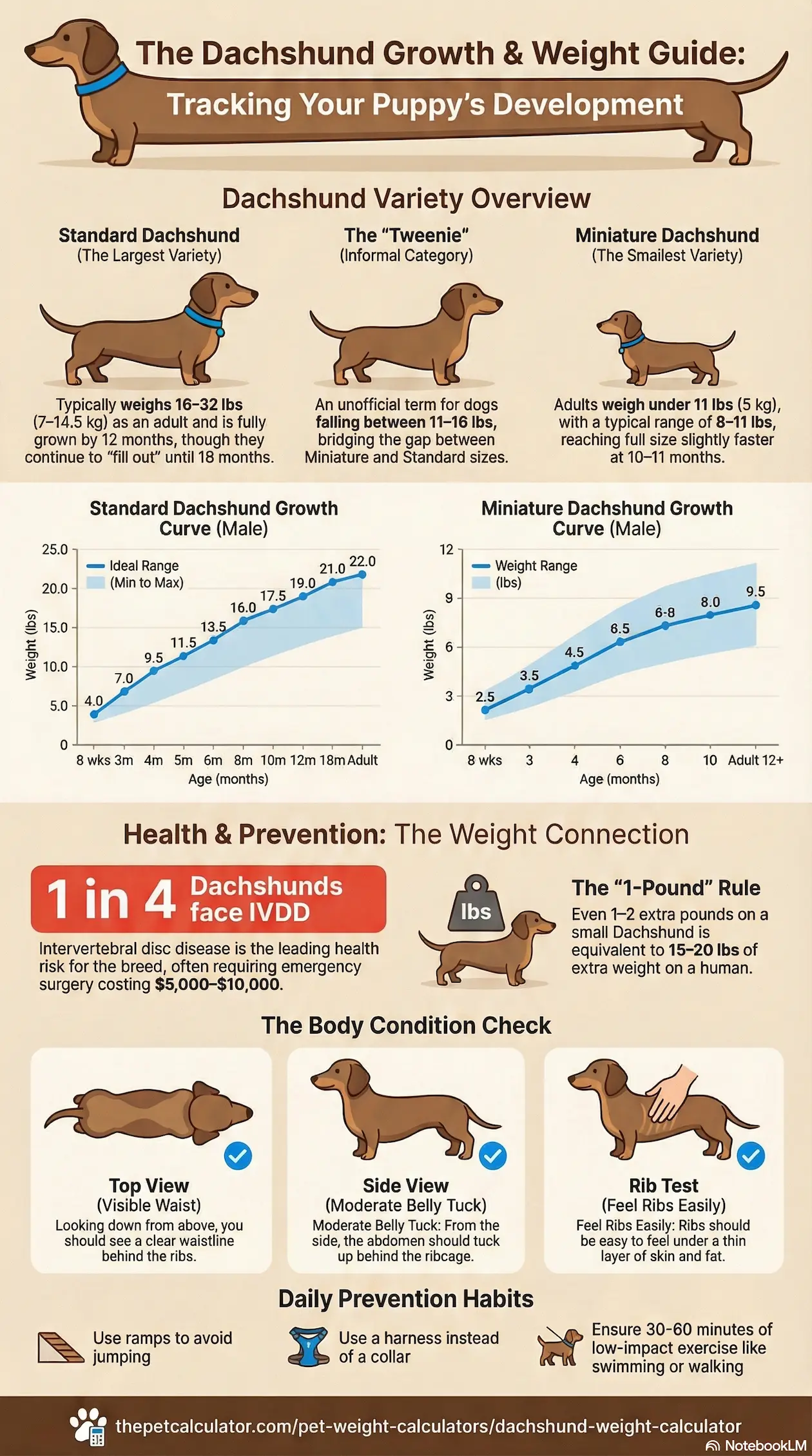
Dachshund growth and weight guide infographic — standard and miniature dachshund puppy development milestones, growth curves, and healthy weight ranges by age
Dachshund growth milestones and puppy weight guide — Standard and Miniature varieties. thepetcalculator.com

Dachshund IVDD and Spine Health: Why Weight Matters More for This Breed

Intervertebral disc disease (IVDD) is the single most important health risk for Dachshunds. Their chondrodystrophic body type — the genetic dwarfism that gives them their characteristic short legs and long spine — means the intervertebral discs between their vertebrae degenerate earlier and more severely than in most other breeds. Studies suggest that 1 in 4 Dachshunds will experience some degree of IVDD in their lifetime.

IVDD occurs when a disc bulges, herniates, or ruptures into the spinal canal, pressing on the spinal cord. Symptoms range from mild pain and reluctance to move, through to loss of coordination, inability to walk, and in the most severe cases, complete paralysis of the hind legs and loss of bladder control. Emergency surgery can cost $5,000–$10,000 and does not always restore full mobility.

The connection to weight is direct and well-documented. Every extra pound on a Dachshund increases the mechanical load on an already vulnerable spine. Research published in the Journal of Veterinary Internal Medicine found that overweight Dachshunds had significantly higher rates of disc herniation. Because Dachshunds are small dogs, even 1–2 extra pounds is proportionally enormous — equivalent to a human carrying an extra 15–20 lbs.

Beyond weight management, you can protect your Dachshund's spine by using ramps for furniture and cars (no jumping), always supporting their full body when picking them up, using a harness instead of a collar, and providing regular low-impact exercise. Swimming is particularly beneficial as it strengthens the muscles supporting the spine without compressing the discs.

Dachshund IVDD Spine Disc Diagram — Healthy vs HerniatedA medical diagram showing a Dachshund's spine cross-section comparing a healthy intervertebral disc to a herniated disc, with callouts showing how excess weight increases spinal compression and IVDD risk.How Weight Damages a Dachshund's Spine (IVDD)Dachshunds carry 1 in 4 lifetime risk — excess weight multiplies itHEALTHY DISC — IDEAL WEIGHTVERTEBRAHealthy Disc — Full CushionVERTEBRASpinalcord clearNormal load✓ Disc absorbs shock fully✓ Spinal cord protected✓ Low IVDD riskHERNIATED DISC — OVERWEIGHTVERTEBRACrushed / Herniated DiscBULGEpressingon cordVERTEBRAExcess weight load✗ Disc flattened under load✗ Material presses on cord✗ Pain, paralysis, surgery $5–10KEven 1–2 extra lbs on a Dachshund significantly increases disc compression — thepetcalculator.com

Why weight is life-or-death for Dachshunds: excess load flattens the intervertebral discs, causing the material to press on the spinal cord.

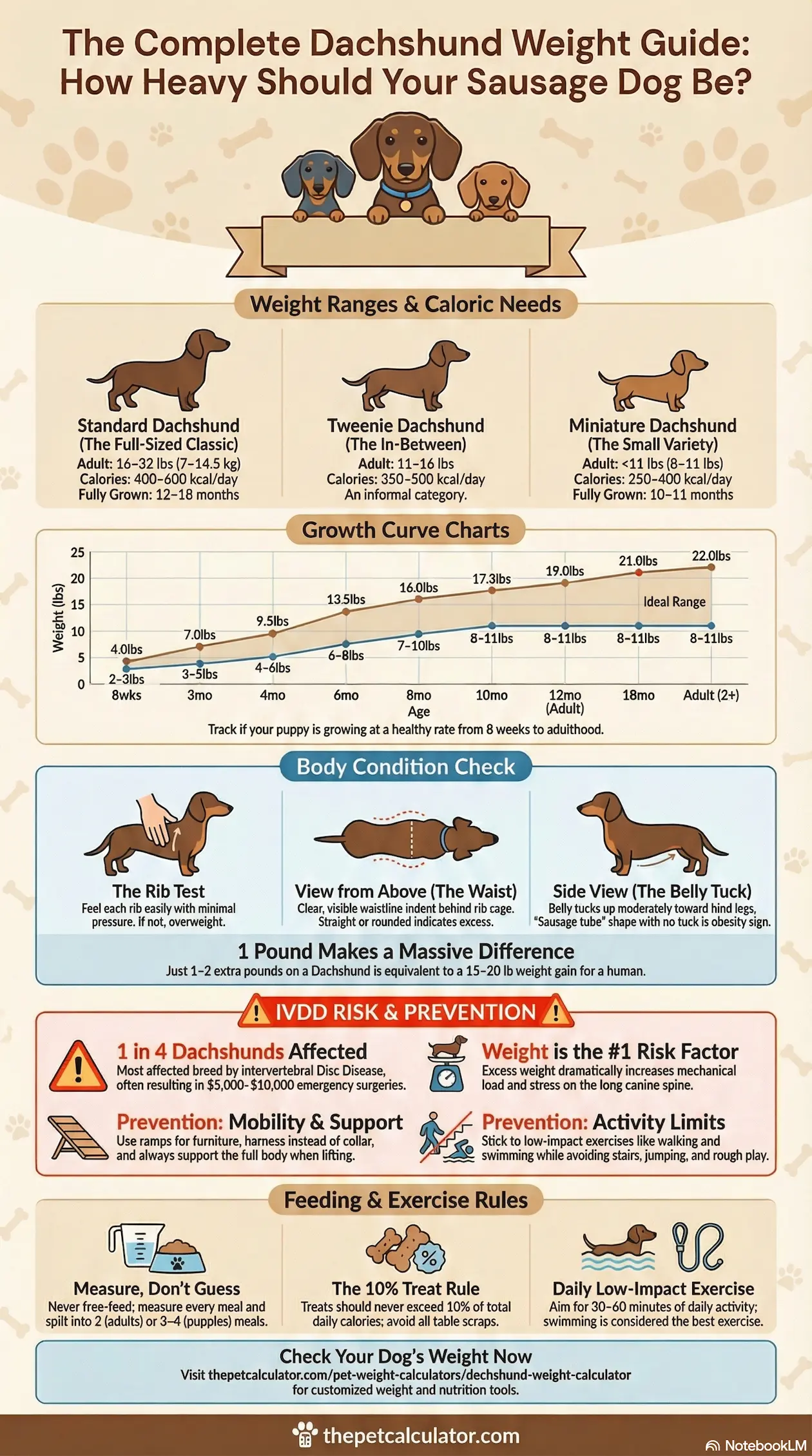
Dachshund weight IVDD and feeding guide infographic — caloric needs by variety, body condition score check, IVDD risk prevention, and daily feeding and exercise rules for sausage dogs
Complete Dachshund weight guide: caloric needs, IVDD prevention, and feeding rules. thepetcalculator.com

Dachshund Body Condition Score: Visual Guide

Use these simplified top-down and side-view silhouettes to visually assess your Dachshund's body condition. This is the same method vets use — adapted for the Dachshund's unique long-bodied shape.

Underweight

TOP VIEW SIDE VIEW
  • • Ribs, spine, and hip bones easily visible
  • • Exaggerated waist tuck from above
  • • Very pronounced belly tuck from side
  • • Minimal muscle mass

Ideal Weight

TOP VIEW SIDE VIEW
  • • Ribs easily felt but not visible
  • • Clear waist visible from above
  • • Moderate belly tuck from side
  • • Good muscle tone along spine

Overweight

TOP VIEW SIDE VIEW
  • • Ribs difficult to feel under fat
  • • No visible waist — "sausage tube" shape
  • • No belly tuck, may sag
  • • Fat deposits at neck and tail base

These are simplified visual guides. For a full body condition assessment, use our Dog BMI Calculator or consult your veterinarian.

How Much to Feed a Dachshund: Diet and Portion Guide

Dachshunds are notoriously food-motivated — they will eat far more than they should if given the opportunity. This trait, combined with their vulnerability to back problems from excess weight, makes portion control absolutely critical.

A typical adult Standard Dachshund (16–25 lbs) needs approximately 400–600 calories per day, depending on their size, age, and activity level. Miniature Dachshunds (under 11 lbs) need considerably less — around 250–400 calories per day. Senior or less active Dachshunds may need even fewer calories. Use our Dog Feeding Calculator for a personalised portion recommendation based on your Dachshund's specific details.

Key feeding rules for Dachshunds: Never free-feed (leaving food out all day). Measure every meal with a kitchen scale or measuring cup. Account for treats in the daily calorie total — treats should be no more than 10% of daily calories. Avoid table scraps, which are often calorie-dense and nutritionally poor for dogs. Consider splitting the daily ration into 2 meals for adults, or 3–4 meals for puppies under 6 months.

If your Dachshund needs to lose weight, do not simply cut their food dramatically — this can cause nutritional deficiencies. Instead, use our Dog Weight Loss Calculator to create a safe, gradual weight loss plan. A healthy rate of weight loss for a Dachshund is around 1–2% of body weight per week.

Dachshund Daily Feeding Portions — Standard, Tweenie and MiniatureVisual portion guide showing daily calorie targets and recommended meal splits for all three Dachshund varieties. Helps owners measure correct daily food amounts to prevent obesity.Dachshund Daily Feeding GuideAlways measure meals — Dachshunds will eat far more than they needMEASUREDSTANDARD400–600 kcal/day2 meals × 200–300 kcalNo free-feeding!MEASUREDTWEENIE350–500 kcal/day2 meals × 175–250 kcalTreats ≤ 10% of totalMEASUREDMINIATURE250–400 kcal/day2 meals × 125–200 kcalPuppies: 3–4 meals/dayUse kitchen scales for accuracy. Treats count toward daily total. thepetcalculator.com/pet-feeding-calculators/dog-feeding-calculator

Portion sizes shown are for moderately active adult Dachshunds. Use our Dog Feeding Calculator for a personalised target.

Dachshund Exercise Needs: Keeping Your Sausage Dog Fit Without Hurting Their Back

Despite their small stature, Dachshunds were bred as working hunting dogs and have more stamina than many people expect. An adult Dachshund needs 30–60 minutes of exercise daily, ideally split into two sessions. Regular exercise is essential for maintaining a healthy weight and building the back and core muscles that support their vulnerable spine.

Best exercises: Walking on flat terrain is the foundation. Swimming is excellent — it builds muscle without compressing the spine and many Dachshunds take to water well. Scent work and puzzle toys provide mental stimulation that tires them out without physical strain. Gentle tug-of-war (keeping the toy low to the ground) is also fine for most Dachshunds.

Exercises to avoid: Jumping on and off furniture, running up and down stairs repeatedly, rough wrestling with larger dogs, and any activity that involves significant twisting of the spine. If your Dachshund loves to run, keep it on flat ground and avoid abrupt stops and direction changes. Use our Dog Exercise Calculator for a personalised daily activity target.

How Much Longer Does a Healthy-Weight Dachshund Live?

Research on dog longevity consistently shows that maintaining a healthy weight is one of the single biggest predictors of lifespan. For Dachshunds, the data is stark. A landmark study tracking paired Labrador Retrievers found that the leaner group lived a median of 1.8 years longer. For Dachshunds — whose existing IVDD risk compounds the metabolic strain of obesity — the effect is amplified. Veterinary consensus puts the lifespan cost of chronic obesity in dogs at up to 2.5 years.

Dachshund Lifespan Impact — Healthy Weight vs OverweightA horizontal bar chart comparing the expected lifespan of a healthy-weight Dachshund versus an overweight Dachshund, showing the up to 2.5 year lifespan reduction associated with obesity.Dachshund Lifespan: Weight Makes a Measurable DifferenceHealthy WeightOverweightObese12–16 yrsFull expected lifespan~14 yrsModerately overweight~1–2 yrslost~13 yrsObese / chronically overweightUp to 2.5 yrs lostto obesityBased on veterinary longevity research. Every year matters — keeping your Dachshund lean is the single highest-return health investment. thepetcalculator.com

Healthy-weight Dachshunds live measurably longer. Combined with dramatically lower IVDD risk, maintaining ideal weight is the single highest-return health decision you can make for your sausage dog.

When to See a Vet About Your Dachshund's Weight

Consult your veterinarian promptly if you notice any of the following:

  • Sudden weight gain or loss — unexplained changes of more than 5–10% of body weight over a few weeks can indicate thyroid issues, diabetes, or other conditions.
  • Reluctance to move, jump, or climb stairs — this can be an early sign of IVDD or back pain, especially if your Dachshund previously did these things willingly.
  • Hunched back or stiff gait — arching of the back, sensitivity to touch along the spine, or a wobbly/uncoordinated gait are IVDD warning signs.
  • Dragging hind legs or loss of bladder control — these are emergency signs of severe IVDD. Seek veterinary care immediately.
  • Yelping when picked up or touched — this often indicates spinal pain, which in Dachshunds should always be taken seriously.
  • Your Dachshund is significantly over the weight ranges shown in the calculator above — your vet can help rule out medical causes and create a safe weight loss plan.

Dachshund Weight Quick Reference

VarietyAdult WeightFully Grown ByDaily Calories
Standard16–32 lbs12 months400–600 kcal
Tweenie11–16 lbs11–12 months350–500 kcal
MiniatureUnder 11 lbs10–11 months250–400 kcal

For personalised calorie and feeding recommendations, try our Dog Nutrition Calculator or Dog Feeding Calculator. To check your dog's overall body condition, use our Dog BMI Calculator.

Dachshund Weight in Kg: Metric Conversion Chart

Many Dachshund owners outside the United States — and many vets worldwide — use kilograms rather than pounds. Here is a quick metric conversion for all three Dachshund size varieties:

VarietyWeight (lbs)Weight (kg)Ideal Weight (kg)
MiniatureUnder 11 lbsUnder 5 kg3.5–5 kg
Tweenie11–16 lbs5–7.3 kg5–7 kg
Standard16–32 lbs7.3–14.5 kg9–11 kg
Kaninchen8–11 lbs3.5–5 kg3.5–4.5 kg

To convert lbs to kg, multiply by 0.4536. To convert kg to lbs, multiply by 2.2046.

Dachshund Weight by Coat Type: Smooth, Wirehaired, and Longhaired

Dachshunds come in three coat varieties — Smooth (short-haired), Wirehaired, and Longhaired — and each occurs in both Standard and Miniature sizes. A common question is whether coat type affects weight. The short answer: not significantly, but there are subtle differences worth knowing.

Smooth Dachshunds are the most common variety and the benchmark for breed weight standards. Their sleek coat adds negligible weight, so what you see on the scale closely reflects body mass.

Longhaired Dachshunds — both standard and miniature longhaired Dachshunds — may appear slightly larger due to their flowing coat, but the coat itself adds minimal actual weight (typically under half a pound). A miniature long haired Dachshund weight follows the same 8–11 lb adult range as a smooth mini.

Wirehaired Dachshunds often have a slightly stockier, more robust build than their smooth counterparts. The wire haired Dachshund weight can sit at the higher end of the breed range — a wirehaired standard male may comfortably weigh 25–30 lbs where a smooth male of the same height might weigh 20–26 lbs. This is due to their terrier-influenced bone structure and muscle, not excess fat. A miniature wire haired Dachshund weight similarly tends toward the upper end of the Mini range (9–11 lbs).

The bottom line: use the same weight ranges regardless of coat type, but don't be alarmed if your wirehaired Dachshund is slightly heavier than a smooth Dachshund of similar height. The body condition score (rib check, waist check, belly tuck) matters more than the number on the scale.

Kaninchen Dachshund Weight: The Smallest Variety

The Kaninchen (German for "rabbit") Dachshund is the smallest Dachshund variety, recognised by the FCI (World Canine Organisation) but not by the AKC. Kaninchen Dachshunds were bred to hunt rabbits in their burrows and are significantly smaller than even Miniature Dachshunds.

An adult Kaninchen Dachshund typically weighs 8–11 lbs (3.5–5 kg) and has a chest circumference of no more than 30 cm (12 inches) when measured at the age of 15 months or older. They are most common in Europe and are increasingly popular in the UK and Australia.

Because of their tiny size, even a single extra pound on a Kaninchen Dachshund is proportionally enormous — equivalent to a human carrying an extra 25–30 lbs. Weight management is even more critical for this variety than for Standards. The same IVDD risks apply, and their tiny frames are even less tolerant of excess weight.

Fat Dachshund? Why Sausage Dogs Are Prone to Weight Gain

"Fat Dachshund" is one of the most-searched terms for this breed — and unfortunately, overweight sausage dogs are extremely common. Studies suggest that over 50% of pet Dachshunds are overweight or obese. Here is how to tell if your Dachshund is fat and what to do about it.

Fat dachshund — overweight sausage dog compared to healthy weight dachshund

Is your Dachshund carrying extra weight? Even 1–2 lbs makes a big difference for this breed.

Fat Dachshund vs Healthy Dachshund Weight ComparisonAn infographic comparing an overweight fat Dachshund to a healthy weight Dachshund, showing the body shape differences from top-down and side views, plus key health risks of obesity in sausage dogs.Is My Dachshund Fat? Visual Weight CheckCompare your Dachshund's body shape to these silhouettesHEALTHY WEIGHTTOP VIEWwaist visibleSIDE VIEWbelly tuck✓ Ribs easily felt✓ Clear waist from above✓ Belly tucks up✓ Spine health protectedStandard: 16–32 lbs | Mini: under 11 lbsOVERWEIGHT / FATTOP VIEWno waist — tube shapeSIDE VIEWno belly tuck — sagging✗ Ribs hard to feel under fat✗ No waist — "stuffed sausage"✗ Belly hangs or drags✗ Fat pads at neck and tailEven 1–2 extra lbs = 15–20 lbs on a humanWhy a Fat Dachshund Is a Health EmergencyIVDD / Slipped Disc1 in 4 Dachshunds affectedExcess weight = higher riskDiabetesObese dogs 3x more likelyto develop Type 2 diabetesJoint DamageShort legs bear more loadArthritis risk increasesShorter LifespanOverweight dogs liveup to 2.5 years lessThink your Dachshund might be overweight?Use the free calculator above to check — then get a personalised weight loss planHow Extra Weight Translates for a Dachshund+1 lb= +10–15 lbs on a human+3 lbs= +30–45 lbs on a humanthepetcalculator.com — Free Dachshund Weight Calculator

Fat Dachshund vs healthy Dachshund: visual body shape comparison. Use the body condition checks above to assess your own sausage dog.

There are several reasons why Dachshunds are especially prone to becoming overweight:

They are exceptionally food-motivated. Dachshunds were bred to track scent and pursue prey with single-minded determination. That same drive applies to food — they will beg, steal, and manipulate their way to extra calories. Many owners find it difficult to resist those big eyes.

Their body shape hides weight gain. Because Dachshunds are already "sausage-shaped," it can be harder to notice when they're carrying extra weight. A Labrador with 5 extra pounds looks visibly chubby; a Dachshund with 5 extra pounds may just look like a slightly plumper sausage. By the time the weight gain is obvious, they may be 20–30% over their ideal weight.

Their exercise is often restricted. Because of IVDD risk, many owners limit their Dachshund's activity — sometimes too much. While high-impact exercise should be avoided, regular walking and swimming are essential. An under-exercised Dachshund who eats the same portions will steadily gain weight.

Spaying and neutering reduces metabolism. Like all breeds, spayed/neutered Dachshunds have slightly lower calorie needs. If portions aren't adjusted after the procedure, weight gain follows.

If your Dachshund is overweight, the first step is to use the calculator above to understand how far they are from their ideal range. Then use our Dog Weight Loss Calculator to create a safe, gradual weight loss plan. Even losing 1–2 lbs can significantly reduce the mechanical stress on their spine and lower IVDD risk.

Dachshund Slipped Disc, Ruptured Disc, and Other Disc Problems

When people search for "Dachshund slipped disc" or "Dachshund ruptured disc," they are typically referring to intervertebral disc disease (IVDD) — the most significant health concern for this breed. Here is a breakdown of the disc problems Dachshunds face and how they relate to weight:

Bulging disc (protrusion): The disc pushes outward but does not rupture. This is the most mild form and may cause intermittent pain, stiffness, or reluctance to jump. An overweight Dachshund puts constant extra pressure on bulging discs, accelerating their deterioration.

Slipped disc (herniation): The disc's soft centre pushes through the outer ring and presses on the spinal cord. Symptoms include severe pain, wobbliness, and difficulty walking. A Dachshund slipped disc is a veterinary emergency that often requires surgery costing $5,000–$10,000.

Ruptured disc (extrusion): The most severe form — the disc material completely ruptures into the spinal canal. This can cause sudden paralysis of the hind legs and loss of bladder control. Emergency surgery within 24 hours gives the best chance of recovery.

Calcified disc: Over time, Dachshund discs can become calcified (hardened) due to their chondrodystrophic genetics. Calcified discs are brittle and more prone to herniation. While calcification itself isn't always symptomatic, it increases the risk of a sudden rupture. Weight management, avoiding jumping, and using ramps are critical preventive measures.

Laser therapy for Dachshunds: Low-level laser therapy (also called cold laser therapy) is increasingly used as a non-surgical treatment for mild to moderate disc problems. It can reduce inflammation and pain. However, it is not a substitute for surgery in severe cases and does not replace the importance of maintaining a healthy weight.

The connection between weight and disc problems is direct: every extra pound increases the load on already-vulnerable discs. Keeping your Dachshund at or below their ideal weight — as shown in the calculator above — is the single most impactful thing you can do to reduce disc disease risk.


Dachshund Mix Weight: Chiweenie and Other Common Crosses

Dachshund mixes — particularly the Dachshund Chihuahua mix (commonly called a "Chiweenie") — are increasingly popular. If you have a Dachshund mix, our calculator's breed-specific ranges won't apply directly, but they can still serve as a useful reference point.

A Chiweenie (Dachshund × Chihuahua) typically weighs 5–12 lbs as an adult, depending on the size of the parents. They inherit the Dachshund's long body to varying degrees, and many also inherit some IVDD susceptibility — so weight management is still important.

Other common Dachshund mixes include the Dorgi (Dachshund × Corgi, 15–28 lbs), Doxle (Dachshund × Beagle, 16–32 lbs), and Dachshund Lab mix (15–40 lbs depending on the generation). For any Dachshund mix, use the parent breeds' weight ranges as a guide and consult your vet to determine your specific dog's ideal weight. Our general Dog Weight Calculator may be more appropriate for mixed breeds.

Newborn Dachshund Weight and Early Puppy Milestones

Newborn Standard Dachshund puppies typically weigh between 5–7 oz (140–200 g) at birth. Miniature Dachshund newborns are even smaller, usually 3–5 oz (85–140 g). These tiny puppies should gain weight rapidly in their first weeks:

Week 1–2: Puppies should roughly double their birth weight. They are entirely dependent on their mother's milk at this stage. Weight gain is the single best indicator that a newborn puppy is healthy and feeding well. If a puppy is not gaining weight or is losing weight, contact your vet immediately.

Week 3–4: Puppies begin to open their eyes and ears and start becoming more active. Weight gain continues steadily. By 4 weeks, a Standard Dachshund puppy typically weighs 1.5–3 lbs and a Mini weighs about 1–2 lbs.

Week 6–8: Puppies are weaned and eating solid puppy food. By 8 weeks — when most puppies go to their new homes — a Standard Dachshund puppy weighs approximately 3–5 lbs and a Mini weighs 1.5–3 lbs. This is the starting point for the growth charts shown above.

10 weeks: An 8–10 week old Dachshund puppy should be gaining weight steadily. A 10-week-old Standard puppy typically weighs 4–7 lbs, while a Mini at 10 weeks weighs about 2–4 lbs. If your puppy is significantly outside these ranges, consult your vet to ensure they're growing properly.

FAQs

Frequently Asked Questions

What is the ideal weight for a Standard Dachshund?

Adult Standard Dachshunds should weigh between 16–32 lbs (7–14.5 kg). The AKC breed standard describes Standard Dachshunds as typically over 11 lbs. Dogs in the 16–24 lb range tend to be in the healthiest range for back health.

What is the ideal weight for a Miniature Dachshund?

Miniature Dachshunds should weigh under 11 lbs (5 kg) at 12 months of age and older. The AKC breed standard sets the Miniature Dachshund weight limit at 11 lbs. If your Mini Dachshund is approaching or exceeding this, consult your vet about a weight management plan.

What is a Tweenie Dachshund and how much should one weigh?

A "Tweenie" Dachshund is an informal term for a Dachshund that falls between the Miniature and Standard size classifications — typically weighing 11–16 lbs. Tweenies are not a separate AKC-recognised variety, but the term is widely used by breeders and owners. If your Dachshund weighs between 11 and 16 lbs as an adult, they are likely a Tweenie. The same weight management and spine health principles apply.

Why is weight so critical for Dachshunds?

Dachshunds have a uniquely long spine relative to their leg length, making them highly susceptible to intervertebral disc disease (IVDD) — a painful and potentially paralysing spinal condition. Excess body weight dramatically increases the mechanical load on the spine. Studies show overweight Dachshunds have significantly higher rates of IVDD. Weight management may be the single most impactful health decision you make for your Dachshund.

What is IVDD in Dachshunds?

Intervertebral disc disease (IVDD) is a condition where the cushioning discs between the vertebrae of the spine bulge, herniate, or rupture into the spinal cord space. Dachshunds are the breed most commonly affected due to their chondrodystrophic (dwarf) body type — their long spine and short legs put constant stress on the intervertebral discs. IVDD can cause pain, loss of coordination, partial or full paralysis, and in severe cases requires emergency surgery. Keeping your Dachshund at a healthy weight is one of the most effective ways to reduce IVDD risk.

How can I tell if my Dachshund is overweight?

Feel the ribcage with flat fingers — you should be able to feel each individual rib easily. The waist should be clearly visible from above. From the side, the belly should have a moderate tuck. If your Dachshund looks like a stuffed sausage with no visible waist or belly tuck, they are likely overweight. Even 1–2 extra pounds on a Dachshund is proportionally significant — equivalent to 15–20 lbs on a human.

How can I prevent IVDD in my Dachshund?

While IVDD has a genetic component and cannot be entirely prevented, you can significantly reduce the risk. Keep your Dachshund at a healthy weight (the single biggest factor you can control). Use ramps instead of letting them jump on and off furniture or stairs. Support their full body when picking them up — never lift a Dachshund by the front legs alone. Provide regular low-impact exercise like walking or swimming. Avoid activities that involve jumping, twisting, or rough play.

At what age is a Dachshund fully grown?

Standard Dachshunds typically reach adult size by 12 months but may fill out slightly until 18 months. Miniature Dachshunds may reach their adult weight slightly earlier, around 10–11 months. If your Dachshund is still gaining weight after 18 months, it is likely fat gain rather than growth — consult your vet.

What should I feed my Dachshund to keep them at a healthy weight?

Dachshunds are highly food-motivated and should never be free-fed. Use measured portions and a calorie-appropriate adult dog food. Avoid high-calorie treats and table scraps. A typical adult Standard Dachshund needs around 400–600 calories per day depending on activity level and size. Use our Dog Nutrition Calculator to find the right daily calorie target for your Dachshund's specific weight and age.

How much should I feed a Miniature Dachshund puppy?

Miniature Dachshund puppies should be fed a high-quality puppy food formulated for small breeds, split into 3–4 meals per day until 6 months of age, then 2 meals per day. Portion sizes depend on the specific food's calorie density and your puppy's current weight. Avoid overfeeding — a chubby Mini Dachshund puppy is not a healthy one. Use our Dog Feeding Calculator for personalised portion recommendations.

How much should a Mini Dachshund weigh at 6 months?

A male Miniature Dachshund at 6 months typically weighs 6–8 lbs, while a female weighs around 5–7 lbs. At this age they are approaching but have not yet reached their adult weight. If your Mini Dachshund puppy weighs significantly more than this, consult your vet to rule out overfeeding or to confirm they may actually be a Standard or Tweenie size.

Should I use a harness instead of a collar for my Dachshund?

Yes — a harness is strongly recommended for Dachshunds. A collar puts pressure on the neck and upper spine, which can aggravate or contribute to disc problems. A well-fitted harness distributes force across the chest and shoulders, protecting the vulnerable spine. This is especially important for Dachshunds that pull on the lead.

How much exercise does a Dachshund need?

Adult Dachshunds need around 30–60 minutes of exercise per day, split into two walks. Despite their small size, they were originally bred to hunt badgers and have good stamina. However, exercise should be low-impact — avoid excessive stair climbing, jumping, and high-impact activities. Swimming is an excellent exercise for Dachshunds as it builds muscle without stressing the spine. Use our Dog Exercise Calculator for a personalised recommendation.

What is the average weight of a Dachshund?

The average weight depends on the variety. Standard Dachshunds average 16–32 lbs, with most falling around 20–25 lbs. Miniature Dachshunds average 8–11 lbs. Males tend to be slightly heavier than females in both varieties. Coat type (Smooth, Wirehaired, or Longhaired) does not significantly affect weight, though Wirehaired Dachshunds may have a slightly stockier build.

What is a Kaninchen Dachshund and how much should one weigh?

A Kaninchen (rabbit) Dachshund is the smallest Dachshund variety, recognised by the FCI (World Canine Organisation) but not by the AKC. They were bred to hunt rabbits in their burrows. An adult Kaninchen Dachshund weighs 8–11 lbs (3.5–5 kg) and has a chest circumference under 30 cm. They are most common in Europe. Because of their tiny size, even a single extra pound is proportionally enormous — weight management is even more critical than for Standard Dachshunds.

How much does a Dachshund weigh in kg?

Standard Dachshunds weigh 7.3–14.5 kg (16–32 lbs) as adults, with most settling around 9–11 kg. Miniature Dachshunds weigh under 5 kg (11 lbs). Tweenie Dachshunds fall between 5–7.3 kg (11–16 lbs). To convert your Dachshund's weight from lbs to kg, multiply by 0.4536. To convert from kg to lbs, multiply by 2.2046.

Does coat type affect a Dachshund's weight?

Coat type (Smooth, Wirehaired, or Longhaired) does not significantly change a Dachshund's expected weight range. However, Wirehaired Dachshunds often have a slightly stockier, more robust build due to their terrier-influenced bone structure, so they may sit at the higher end of the breed range. A wirehaired standard male may weigh 25–30 lbs where a smooth male of the same height might weigh 20–26 lbs. Longhaired Dachshunds may appear larger due to their coat but the coat itself adds negligible weight.

How much does a newborn Dachshund puppy weigh?

Newborn Standard Dachshund puppies weigh 5–7 oz (140–200 g) at birth. Miniature Dachshund newborns are smaller, typically 3–5 oz (85–140 g). Puppies should roughly double their birth weight in the first 1–2 weeks. By 8 weeks, a Standard puppy weighs 3–5 lbs and a Mini weighs 1.5–3 lbs. Steady weight gain in the first weeks is the best indicator of a healthy, well-fed newborn.

What is a Dachshund slipped disc?

A "slipped disc" in a Dachshund refers to intervertebral disc disease (IVDD) — specifically, when a disc herniates and presses on the spinal cord. Dachshunds are the breed most prone to slipped discs due to their long spine and short legs. Symptoms include pain, wobbliness, reluctance to move, and in severe cases, paralysis. Overweight Dachshunds have significantly higher rates of disc problems. Maintaining a healthy weight, using ramps, and supporting their full body when lifting are key preventive measures.

Is my Dachshund fat? How can I tell?

To check if your Dachshund is fat, do the rib test: place your hands on their ribcage and press gently — you should feel each rib easily without pressing hard. Look from above — there should be a visible waist between the ribs and hips. From the side, the belly should tuck up, not hang down or drag. If your Dachshund looks like a "stuffed sausage" with no waist definition, they are likely overweight. Even 1–2 extra pounds on a Dachshund is equivalent to 15–20 lbs on a human. Use our calculator above to check their weight against healthy ranges.

How much should a Dachshund Chihuahua mix (Chiweenie) weigh?

A Chiweenie (Dachshund × Chihuahua mix) typically weighs 5–12 lbs as an adult, depending on the size of the parents. They inherit the Dachshund's long body to varying degrees and many also inherit some IVDD susceptibility, so weight management remains important. For Dachshund mixes, the breed-specific ranges in our calculator won't apply directly — use our general Dog Weight Calculator as a starting point and consult your vet.

Other Calculators for Dogs


Other Pet Weight Calculators


Ads.txt