Dog Calorie Calculator — Free Daily Calorie & Nutrition Tool by Breed
Free dog calorie calculator. How many calories does my dog need? Calculate your dog

Enter your French Bulldog's sex, age, and current weight to check if they are within the healthy weight range for their stage of life.
French Bulldogs are a compact, muscular breed with a characteristic flat face, bat ears, and stocky build. Despite their small stature, they are solid and heavy for their size. French Bulldogs have become one of the most popular breeds in the US and UK. They are prone to obesity due to their love of food and relatively low exercise needs, making weight management especially important. The breed has seen explosive growth in popularity — with it comes heightened interest in proper care including healthy weight ranges.
French Bulldogs are a compact, muscular small-to-medium breed with a characteristic flat face, bat ears, and stocky build. Despite their small stature, they are surprisingly heavy for their size — a trait that makes weight management especially important.
Male French Bulldogs typically weigh between 20–28 lbs (9–12.7 kg) as adults. Males tend to be stockier and more muscular than females, with broader chests and thicker necks. The AKC breed standard sets the upper weight limit at 28 lbs.
Female French Bulldogs typically weigh between 17–24 lbs (7.7–10.9 kg) as adults. Females are slightly lighter and less muscular, though they share the same compact, heavy-boned build. A healthy female Frenchie is solid and muscular without being barrel-shaped.
Because French Bulldogs are brachycephalic (flat-faced), their compact build concentrates weight in a small frame. Even 2–3 extra pounds is proportionally significant — equivalent to roughly 10–15 extra pounds on a human — and directly worsens breathing difficulties.
This chart shows the expected weight range for French Bulldogs from puppyhood to adulthood. French Bulldogs grow rapidly in their first 6 months, then growth slows as they approach their adult size by 12–14 months.
| Age | Male (lbs) | Female (lbs) |
|---|---|---|
| 8 weeks | 3.5–5.5 lbs | 3–5 lbs |
| 3 months | 6–9 lbs | 5–8 lbs |
| 4 months | 9–12 lbs | 7.5–11 lbs |
| 5 months | 11–15 lbs | 9.5–13 lbs |
| 6 months | 13–17 lbs | 11–15 lbs |
| 8 months | 15–20 lbs | 13–17 lbs |
| 10 months | 17–22 lbs | 14–19 lbs |
| 12 months | 18–25 lbs | 15–21 lbs |
| 18 months | 19–27 lbs | 16–22 lbs |
| Adult (2+ years) | 20–28 lbs | 17–24 lbs |
Weight data based on AKC breed standards and veterinary growth references. Individual dogs may vary — consult your vet if your Frenchie falls significantly outside these ranges.
Male French Bulldogs are consistently heavier than females at every age. The chart below overlays both growth curves so you can see the difference. The shaded bands represent the healthy weight range for each sex.
Average growth curves for Male (blue) and Female (pink) French Bulldogs. Shaded bands show the healthy weight range for each sex.
French Bulldogs are a small-to-medium breed that reaches adult size relatively quickly. Here is the general growth timeline:
0–4 months: Rapid growth phase. French Bulldog puppies grow quickly, roughly tripling their birth weight in the first month. By 4 months, most Frenchies have reached about 50% of their adult weight. Their characteristic bat ears become erect during this period.
4–8 months: Growth continues steadily but begins to slow. The compact, muscular French Bulldog build becomes clearly defined. Chest width and muscle mass increase noticeably. This is when the breed's distinctive stocky proportions take shape.
8–12 months: Growth tapers significantly. French Bulldogs typically reach their adult height by 9–12 months and are approaching their adult weight. Males may still be filling out in muscle mass.
12–18 months: Most French Bulldogs are at or very near their adult weight by 12–14 months. Some males continue to add muscle mass until 18 months. Any continued weight gain after 18 months is almost certainly fat, not growth — reassess their diet and exercise using our Dog Nutrition Calculator.
Brachycephalic Obstructive Airway Syndrome (BOAS) is the most significant weight-related health concern for French Bulldogs. Their flat face and shortened skull create multiple anatomical restrictions: narrowed nostrils (stenotic nares), an elongated soft palate that partially blocks the airway, a narrowed trachea, and everted laryngeal saccules. Studies estimate that over 50% of French Bulldogs are affected by BOAS to some degree.
The connection between weight and BOAS is direct and well-documented. Excess body fat deposits around the pharynx and neck further narrow an already-compromised airway. Overweight French Bulldogs require more oxygen to support their larger body mass, but their restricted airway cannot deliver it efficiently. This creates a dangerous mismatch that worsens with even modest weight gain.
Symptoms of BOAS worsened by weight: loud or laboured breathing, excessive snoring, gagging or retching, exercise intolerance (tiring after just a few minutes of activity), cyanosis (blue-tinged gums from oxygen deprivation), and in severe cases, collapse — particularly in warm weather when the body demands even more oxygen for cooling.
Keeping your French Bulldog at or below their ideal weight is the single most impactful thing you can do to manage BOAS. Research shows that even a 10% reduction in body weight can meaningfully improve airflow and reduce respiratory distress in brachycephalic breeds.
Every extra pound on a French Bulldog narrows an already-compromised airway. Even modest weight loss can meaningfully improve breathing.
"Fat French Bulldog" is one of the most-searched terms for this breed — and unfortunately, overweight Frenchies are extremely common. Their compact, stocky build can make it hard to spot weight gain until it becomes a serious health issue. Here is how to assess your French Bulldog's weight and what to do about it.
The body condition score (BCS) method is the gold standard for assessing whether your French Bulldog is at a healthy weight. It uses three simple visual and tactile checks that you can do at home:
1. The rib check: Place your hands flat on your Frenchie's ribcage and press gently. You should be able to feel each individual rib without pressing hard. If you need to press firmly to find them, your dog is carrying excess fat. If ribs are prominently visible without touching, your dog may be underweight.
2. The waist check (top view): Look at your French Bulldog from directly above. Behind the ribs, there should be a slight inward curve — a visible waist. French Bulldogs are naturally broad-chested, but the waist should still be discernible. If your Frenchie looks like a barrel with no waist distinction, they are likely overweight.
3. The belly tuck (side view): From the side, the belly should tuck up slightly behind the ribcage. It should not hang straight down or sag. French Bulldogs have a naturally low-slung body, but there should still be a gentle upward curve to the abdomen.
Because French Bulldogs are compact and muscular, the number on the scale alone can be misleading. A muscular 26 lb male Frenchie may be in perfect condition, while a soft, sedentary 24 lb Frenchie could be overweight. The BCS method accounts for this by assessing body composition, not just weight.
These are simplified visual guides. For a full body condition assessment, use our Dog BMI Calculator or consult your veterinarian.

French Bulldogs are highly food-motivated and will eagerly overeat if given the chance. Combined with their limited exercise capacity due to BOAS, portion control is the primary tool for maintaining a healthy weight.
A typical adult French Bulldog (20–28 lbs) needs approximately 500–700 calories per day, depending on their size, age, activity level, and whether they are spayed/neutered. Puppies need more calories relative to their body weight to support growth, while senior Frenchies need fewer as their metabolism slows.
Key feeding rules for French Bulldogs: Never free-feed (leaving food out all day). Measure every meal with a kitchen scale or measuring cup. Account for treats in the daily calorie total — treats should be no more than 10% of daily calories. Avoid table scraps. Split the daily ration into 2 meals for adults, or 3–4 meals for puppies under 6 months. Use our Dog Feeding Calculator for a personalised portion recommendation.
If your French Bulldog needs to lose weight, reduce their daily intake gradually — never cut food dramatically, as this can cause nutritional deficiencies. Use our Dog Weight Loss Calculator for a safe, gradual plan. A healthy rate of weight loss for a French Bulldog is around 1–2% of body weight per week.
Calorie ranges shown are for moderately active French Bulldogs. Use our Dog Feeding Calculator for a personalised target.
French Bulldogs have an average lifespan of 10–12 years, though individual dogs can live longer with excellent care. A 2024 UK study published in Scientific Reports found the median lifespan of French Bulldogs to be 9.8 years — shorter than many comparable small breeds, largely due to the health complications associated with their brachycephalic anatomy.
The most significant factors affecting French Bulldog longevity are weight management, BOAS severity, and overall veterinary care. Overweight French Bulldogs face a compounded risk profile: excess weight worsens BOAS (reducing quality of life and increasing emergency incidents), accelerates joint degradation, strains the heart, and increases the risk of heat stroke — a leading cause of death in brachycephalic breeds.
Research on canine longevity consistently shows that lean dogs live longer. A landmark study on paired Labrador Retrievers found that the leaner group lived a median of 1.8 years longer. For French Bulldogs — whose existing respiratory compromise amplifies the metabolic burden of obesity — the effect is likely at least as significant. Veterinary consensus places the lifespan cost of chronic obesity in dogs at up to 2.5 years.
The good news: weight is the single most controllable factor. By keeping your French Bulldog at their ideal weight (20–28 lbs for males, 17–24 lbs for females), providing appropriate low-impact exercise, and maintaining regular veterinary check-ups, you give your Frenchie the best chance at a long, comfortable life.
Healthy-weight French Bulldogs live measurably longer. Combined with dramatically better breathing and quality of life, maintaining ideal weight is the single best investment in your Frenchie's health.
French Bulldogs are predisposed to several health conditions, many of which are directly worsened by excess weight. Understanding these risks reinforces why weight management is non-negotiable for this breed.
BOAS (Brachycephalic Obstructive Airway Syndrome): The primary concern. Over 50% of Frenchies are affected. Excess fat deposits around the pharynx narrow the airway further, and increased body mass demands more oxygen than the restricted airway can deliver. Weight loss is often the first treatment recommendation before considering corrective surgery.
Spinal problems (IVDD): French Bulldogs have a relatively high incidence of intervertebral disc disease due to their compact, heavy-boned structure. While not as extreme as Dachshunds, excess weight increases the mechanical load on their spine. Hemivertebrae — a congenital malformation where vertebrae are wedge-shaped — are common in the breed and make the spine more vulnerable to weight-related damage.
Joint problems: Patellar luxation (kneecap dislocation) and hip dysplasia both occur in French Bulldogs. Every extra pound increases the stress on already-compromised joints, accelerating cartilage degradation and arthritis progression.
Heat stroke: Brachycephalic breeds are extremely vulnerable to heat stroke because they cannot pant efficiently. Overweight French Bulldogs are at even greater risk because their larger body mass generates more heat while their compromised airway cannot cool them effectively. Heat stroke can be fatal — it is a leading cause of death in brachycephalic breeds.
Skin fold infections: French Bulldogs have characteristic facial and body skin folds that trap moisture and bacteria. Overweight Frenchies have deeper, more pronounced folds due to excess fat, making infections more frequent and harder to manage.
Many French Bulldog owners outside the United States — and many vets worldwide — use kilograms. Here is a quick metric reference:
| Sex | Weight (lbs) | Weight (kg) | Ideal Range (kg) |
|---|---|---|---|
| Male | 20–28 lbs | 9–12.7 kg | 9.5–11.5 kg |
| Female | 17–24 lbs | 7.7–10.9 kg | 8–10 kg |
To convert lbs to kg, multiply by 0.4536. To convert kg to lbs, multiply by 2.2046.
French Bulldogs need around 30–45 minutes of moderate exercise per day, ideally split into two shorter sessions. Their brachycephalic anatomy limits their exercise capacity — they overheat quickly and cannot pant efficiently to cool down. Exercise management is a critical component of weight control for this breed.
Best exercises for French Bulldogs: Short walks (15–20 minutes) during cooler parts of the day (early morning or evening). Gentle indoor play with toys and puzzle feeders. Scent work — Frenchies have a keen nose and enjoy tracking games. Short, controlled fetch sessions on flat ground.
Exercises to avoid: Long runs or vigorous exercise, any outdoor activity in temperatures above 25°C / 77°F, jumping or high-impact activities that stress their joints and spine, and swimming without a life jacket — most French Bulldogs are poor swimmers due to their heavy, front-loaded build. Never exercise a French Bulldog to the point where they are panting heavily or struggling to breathe.
Because exercise capacity is limited by BOAS, diet is the primary tool for weight management in French Bulldogs. You cannot simply "exercise off" excess calories as you might with a Labrador. Portion control matters more for this breed than almost any other. Use our Dog Exercise Calculator for a personalised activity recommendation.
Consult your veterinarian promptly if you notice any of the following:
| Sex | Adult Weight | Fully Grown By | Daily Calories | Key Health Risk |
|---|---|---|---|---|
| Male | 20–28 lbs | 12–14 months | 500–700 kcal | BOAS |
| Female | 17–24 lbs | 12–14 months | 400–600 kcal | BOAS |
For personalised calorie and feeding recommendations, try our Dog Nutrition Calculator or Dog Feeding Calculator. To check your dog's overall body condition, use our Dog BMI Calculator.
Newborn French Bulldog puppies typically weigh between 8–14 oz (225–400 g) at birth. Most Frenchies are delivered via C-section due to the breed's narrow hips and the puppies' large heads. Weight gain in the first weeks is the best indicator of a healthy, well-fed newborn.
Week 1–2: Puppies should roughly double their birth weight. They are entirely dependent on their mother's milk. If a puppy is not gaining weight or is losing weight, contact your vet immediately.
Week 3–4: Puppies begin to open their eyes and ears and become more active. By 4 weeks, a French Bulldog puppy typically weighs 1.5–3 lbs. Their characteristic bat ears may begin to stand up.
Week 6–8: Puppies are weaned and eating solid puppy food. By 8 weeks — when most puppies go to their new homes — a French Bulldog puppy weighs approximately 3–5.5 lbs. This is the starting point for the growth charts shown above. Feed a high-quality puppy food formulated for small breeds, split into 3–4 meals per day.
"Fat French Bulldog" is among the most-searched terms for this breed, and unfortunately, overweight Frenchies are very common. Several breed-specific factors contribute to this:
They are exceptionally food-motivated. French Bulldogs will beg, steal, and charm their way to extra calories. Many owners find it difficult to resist those big eyes and expressive faces. This food drive, combined with their small size, means even a few extra treats per day can cause significant weight gain over time.
Their exercise capacity is limited by their anatomy. Because of BOAS, French Bulldogs cannot exercise vigorously for long periods, especially in warm weather. This means they burn fewer calories than similarly-sized breeds, making dietary control the primary tool for weight management.
Their compact build hides weight gain. French Bulldogs are naturally stocky and barrel-chested, which can mask the early stages of weight gain. By the time excess weight becomes visually obvious, the dog may already be 15–25% over their ideal weight.
The vicious cycle of weight and breathing. Excess weight worsens BOAS → worse breathing reduces exercise tolerance → less exercise leads to more weight gain → more weight worsens BOAS further. Breaking this cycle early through portion control is critical.
If your French Bulldog is overweight, use the calculator above to see how far they are from their ideal range, then use our Dog Weight Loss Calculator to create a safe, gradual plan. Even losing 2–3 lbs can meaningfully improve breathing and quality of life.
FAQs
Adult male French Bulldogs should weigh between 20–28 lbs (9–12.7 kg), while females typically weigh 17–24 lbs (7.7–10.9 kg). The AKC breed standard sets the upper limit at 28 lbs. French Bulldogs are compact and muscular — they are heavy for their size, so even a few extra pounds is significant.
An adult female French Bulldog should weigh between 17–24 lbs (7.7–10.9 kg). Females are slightly lighter and less muscular than males. At 6 months a female Frenchie typically weighs 11–15 lbs, reaching her adult weight by 12–14 months. If your female French Bulldog weighs over 24 lbs, consult your vet about a weight management plan.
An adult male French Bulldog should weigh between 20–28 lbs (9–12.7 kg). Males are stockier and more muscular than females. At 6 months a male Frenchie typically weighs 13–17 lbs. Most males reach their adult weight by 12–14 months, though they may fill out slightly until 18 months.
Feel the ribcage with flat fingers — you should be able to feel each rib easily without pressing hard. Look from above — there should be a slight waist visible behind the ribs. From the side, the belly should tuck up slightly. If your Frenchie looks barrel-shaped with no visible waist or belly tuck, they are likely overweight. Even 2–3 extra pounds on a French Bulldog is proportionally significant and worsens breathing problems.
French Bulldogs are a brachycephalic (flat-faced) breed prone to Brachycephalic Obstructive Airway Syndrome (BOAS). Excess weight directly worsens breathing difficulties by adding fat deposits around the airway and increasing oxygen demand. An overweight French Bulldog is at significantly higher risk of respiratory distress, heat stroke, and exercise intolerance. Keeping your Frenchie at a healthy weight is the single most impactful thing you can do for their breathing.
Brachycephalic Obstructive Airway Syndrome (BOAS) is a condition affecting flat-faced breeds like French Bulldogs. It involves narrowed nostrils, an elongated soft palate, and a narrowed trachea, all of which restrict airflow. Studies show that over 50% of French Bulldogs are affected to some degree. Symptoms include noisy breathing, snoring, gagging, exercise intolerance, and in severe cases, collapse. Excess weight significantly worsens BOAS because fat deposits narrow the already-compromised airway further.
French Bulldogs typically reach their adult height by 9–12 months but continue to fill out and gain muscle mass until 12–14 months. Some Frenchies may fill out slightly until 18 months. If your French Bulldog is still gaining weight after 18 months, it is likely fat gain rather than growth — consult your vet.
A typical adult French Bulldog (20–28 lbs) needs approximately 500–700 calories per day, depending on their size, age, and activity level. Never free-feed a French Bulldog — measure every meal. Treats should account for no more than 10% of daily calories. Use our Dog Feeding Calculator for a personalised portion recommendation based on your Frenchie's specific weight and activity level.
A male French Bulldog at 6 months typically weighs 13–17 lbs, while a female weighs 11–15 lbs. At this age they are approaching but have not yet reached their adult weight. If your Frenchie puppy weighs significantly more or less than this range, consult your vet to ensure healthy growth.
Adult male French Bulldogs weigh 9–12.7 kg (20–28 lbs) and adult females weigh 7.7–10.9 kg (17–24 lbs). To convert your French Bulldog's weight from lbs to kg, multiply by 0.4536. To convert from kg to lbs, multiply by 2.2046.
Adult French Bulldogs need around 30–45 minutes of moderate exercise per day, split into two shorter sessions. Due to their brachycephalic anatomy, Frenchies overheat easily and should never be exercised vigorously in hot or humid weather. Short walks, gentle play, and indoor enrichment activities are ideal. Swimming is not recommended for most French Bulldogs as their heavy front end makes them poor swimmers — always supervise around water.
To check if your French Bulldog is fat, do the rib test: place your hands on their ribcage and press gently — you should feel each rib easily. Look from above — there should be a slight waist. From the side, the belly should tuck up, not hang straight or sag. French Bulldogs are naturally stocky and muscular, but there is a difference between muscular and fat. If you cannot feel ribs at all, your Frenchie is overweight. Even 2–3 extra pounds significantly worsens breathing issues.
Feed a high-quality dog food formulated for small-to-medium breeds. Look for food with moderate protein (25–30%), moderate fat (12–16%), and added joint support (glucosamine/chondroitin). Avoid foods high in fillers and artificial additives. French Bulldogs are prone to food allergies, so limited-ingredient diets may help if your Frenchie has skin or digestive issues. Always measure portions and avoid table scraps.
French Bulldogs have an average lifespan of 10–12 years, though some live to 14 with excellent care. A 2024 UK study found the median lifespan at 9.8 years. Maintaining a healthy weight is one of the most significant factors in maximising your Frenchie's lifespan — overweight French Bulldogs face compounded risks from BOAS, joint problems, and heart strain.
Most French Bulldogs cannot swim well and are at high risk of drowning. Their heavy, front-loaded body structure, short legs, and flat face make swimming extremely difficult. Never leave a French Bulldog unsupervised near water — pools, ponds, lakes, or even bathtubs. If your Frenchie enjoys water, use a well-fitted canine life jacket at all times.
French Bulldog puppy weight varies by age and sex. At 8 weeks, a Frenchie puppy typically weighs 3–5.5 lbs. At 3 months, 5–9 lbs. At 6 months, 11–17 lbs. By 12 months, males are typically 18–25 lbs and females 15–21 lbs. Use the growth chart and calculator on this page to track your puppy's progress against healthy ranges.
Yes — French Bulldogs are highly food-motivated and have relatively low exercise needs due to their brachycephalic anatomy, making them very prone to weight gain. Their compact build means even small amounts of extra weight are proportionally significant. Combined with their breathing difficulties, weight gain creates a vicious cycle: extra weight worsens breathing, which reduces exercise tolerance, which leads to more weight gain.
Yes — a harness is strongly recommended for French Bulldogs. A collar puts pressure on the neck and trachea, which can worsen breathing problems in brachycephalic breeds. A well-fitted harness distributes pressure across the chest and shoulders, protecting the airway. This is especially important because Frenchies already have compromised airways due to BOAS.
Newborn French Bulldog puppies typically weigh between 8–14 oz (225–400 g) at birth. They should roughly double their birth weight within the first 1–2 weeks. Most French Bulldogs are born via C-section due to the breed's narrow hips and large heads. By 8 weeks, a Frenchie puppy weighs approximately 3–5.5 lbs.
Free dog calorie calculator. How many calories does my dog need? Calculate your dog
Free puppy calorie calculator and nutrition tool. Calculate your puppy\
Free senior dog calorie calculator and nutrition tool. Calculate your senior dog\
Free Beagle weight calculator — check your Beagle\
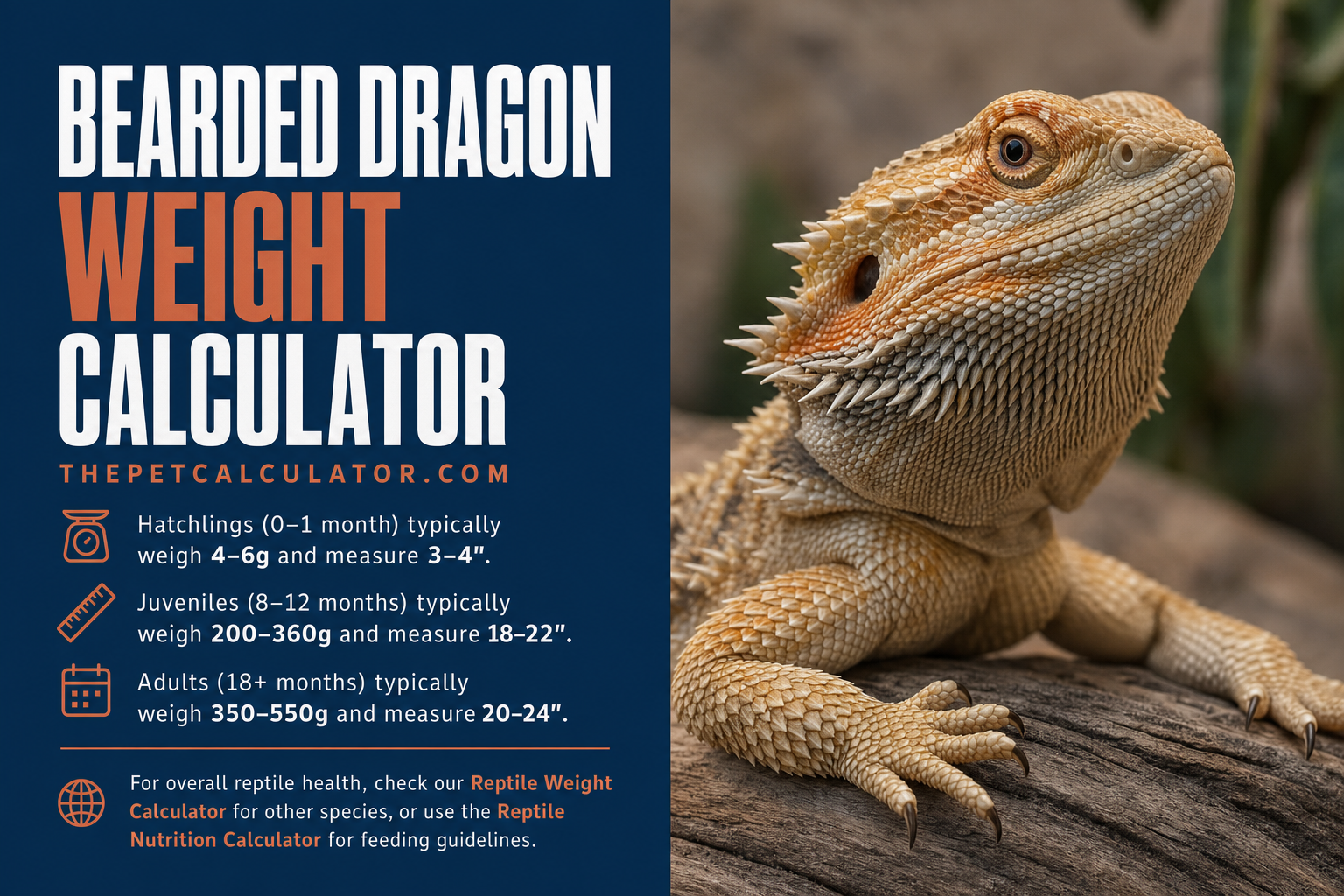
Free bearded dragon weight calculator. Check if your bearded dragon is a healthy weight for their age. Includes weight-by-age chart from hatchling to adult, growth milestones, and care tips.
Free Border Collie weight calculator with breed-specific weight ranges by age and sex. Plus: how big do Border Collies get, when do they stop growing, lifespan data, hip dysplasia risk, feeding guide, and Bordoodle mix size reference.