Last updated: July 17, 2026
Body Condition Assessment
Dog Body Condition Score: Visual BCS Guide
Learn how to assess your dog's body condition using the 1-9 Body Condition Score scale. Includes visual and tactile evaluation guide.
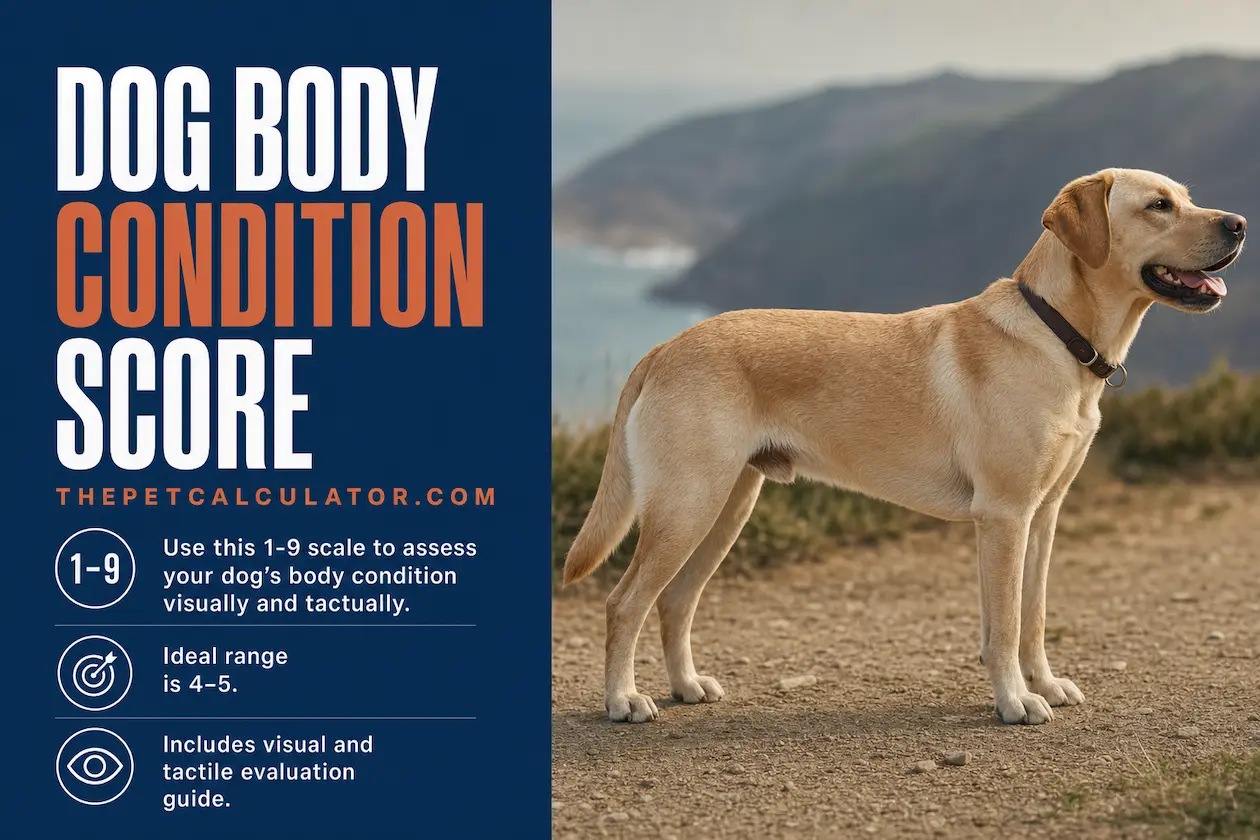
Dog Body Condition Score Guide (1-9)
Use this 1-9 scale to assess your dog's body condition visually and tactually. Ideal range is 4-5.
| BCS | Description | Category |
|---|---|---|
| 1 | Emaciated Ribs, spine, and hip bones are highly visible. No body fat. Severe abdominal tuck. | Underweight |
| 2 | Very Thin Ribs, spine, and hip bones are easily visible. Minimal body fat. Obvious abdominal tuck. | Underweight |
| 3 | Thin Ribs are easily visible. Spine and hip bones are prominent. Clear waist and abdominal tuck. | Underweight |
| 4 | Underweight Ribs are easily felt with minimal fat covering. Waist is easily visible. Abdominal tuck present. | Ideal |
| 5 | Ideal Ribs are easily felt but not visible. Waist is visible behind ribs. Minimal abdominal fat. | Ideal |
| 6 | Overweight Ribs are difficult to feel under fat. Waist is barely visible or absent. Abdominal fat pad present. | Overweight |
| 7 | Heavy Ribs are very difficult to feel under heavy fat layer. No waist. Large abdominal fat pad. | Overweight |
| 8 | Obese Ribs cannot be felt under very heavy fat layer. No waist. Very large abdominal fat pad. Fat deposits on back and base of tail. | Overweight |
| 9 | Severely Obese Massive fat deposits over entire body. Ribs completely obscured. No waist. Extremely large abdominal fat pad. | Overweight |
How to Assess Your Dog's Body Condition
Step-by-step guide to evaluating your dog's health
Feel the Ribs
Run your hands along your dog's rib cage. In an ideal dog (BCS 4-5), ribs should be easily felt but not visible. If ribs are highly visible (BCS 1-3), your dog is underweight. If ribs are difficult to feel under fat (BCS 6-9), your dog is overweight.
Check the Waist
Look at your dog from above. An ideal dog (BCS 4-5) should have a visible waist behind the ribs. If the waist is very pronounced (BCS 1-3), your dog is underweight. If there's no visible waist (BCS 6-9), your dog is overweight.
Examine the Abdomen
Look at your dog from the side. An ideal dog (BCS 4-5) should have minimal abdominal fat and a slight tuck. If there's a severe abdominal tuck (BCS 1-3), your dog is underweight. If there's a large abdominal fat pad (BCS 6-9), your dog is overweight.
Feel the Spine and Hips
Feel along your dog's spine and hip bones. In an ideal dog (BCS 4-5), bones should be easily felt but not prominent. If bones are highly visible (BCS 1-3), your dog is underweight. If bones are difficult to feel (BCS 6-9), your dog is overweight.
Why Body Condition Score Matters
Understanding why BCS is more reliable than weight alone
Accounts for Body Frame
BCS accounts for body frame differences. A small dog may be healthy at 15 pounds, while a large dog may be healthy at 80 pounds. Weight alone doesn't tell the whole story. BCS evaluates actual body fat and muscle mass.
Veterinary Standard
BCS is the standard assessment tool used by veterinarians worldwide. It provides a consistent, objective way to evaluate body condition. Using BCS helps you communicate effectively with your veterinarian about your dog's health.
The Three BCS Categories Explained
The 1-9 Body Condition Score scale collapses into three practical categories. Knowing which one your dog falls into tells you whether to add calories, hold steady, or start a weight loss plan.
Underweight (BCS 1-3)
Ribs, spine, and hip bones are easy to see with little or no fat covering them. There is a severe abdominal tuck and an obvious waist. Dogs in this range may be recovering from illness, dealing with parasites, or simply not eating enough. A vet visit is the safest first step before you start adding calories.
Ideal (BCS 4-5)
Ribs are easily felt with a thin fat covering but are not visible. There is a clear waist when viewed from above and a slight abdominal tuck from the side. This is the target range for most dogs and the condition linked with the longest, healthiest lifespan.
Overweight to Obese (BCS 6-9)
Ribs are hard to feel under a layer of fat, the waist disappears, and fat deposits build over the lower back and tail base. In severe cases (BCS 8-9) the abdomen sags and the dog tires quickly. This range calls for a structured calorie reduction and a follow-up plan with your vet.
BCS vs Weight on the Scale: What Is the Difference?
A number on the bathroom scale only tells you how heavy your dog is, not whether that weight is muscle, fat, or frame. Two dogs of the same breed and the same weight can have very different body conditions. Body Condition Score fills that gap by measuring what the weight is actually made of.
| Factor | Scale Weight | Body Condition Score |
|---|---|---|
| What it measures | Total mass in pounds or kilograms | Proportion of body fat and muscle |
| Accounts for frame | No, a value alone lacks context | Yes, it adapts to any size dog |
| Equipment needed | An accurate scale | Just your hands and eyes |
| Best use | Tracking change over time | Judging whether current weight is healthy |
The two tools work best together. Use BCS to confirm your dog is in the ideal range, then track scale weight monthly to catch drift early.
Common Mistakes When Scoring Your Dog
BCS is simple, but a few habits throw the result off. Avoid these when you assess your dog at home.
- 1.Judging by sight only. A thick or fluffy coat hides body shape. Always use your hands to feel the ribs and spine, not just your eyes.
- 2.Pressing too hard. You should feel ribs with light pressure, the way you feel the back of your own hand. Digging in makes an overweight dog seem ideal.
- 3.Confusing a full belly with fat. Assess after a walk or before a meal so a full stomach does not distort the abdominal tuck.
- 4.Ignoring breed shape. Deep-chested breeds like Greyhounds naturally show more tuck, while barrel-chested breeds hide their waist. Adjust your expectations to the breed.
- 5.Scoring only once. A single check is a snapshot. Repeat monthly so you can spot a trend rather than reacting to one reading.
How Breed and Coat Type Affect BCS
The 1-9 scale applies to every dog, but the way you interpret it shifts with body type. Understanding your dog's build keeps you from misreading a normal shape as a problem.
Deep-chested and lean breeds
Greyhounds, Whippets, and other sighthounds carry very little body fat by design. A visible waist and a light rib outline are normal for them and would signal underweight in a stockier breed. Score these dogs at the leaner end of ideal.
Barrel-chested and stocky breeds
Labradors, Bulldogs, and Pugs hide their waist behind a broad rib cage, and Labs in particular are prone to obesity. Rely more on rib feel than the top-down waist view for these breeds.
Double-coated and fluffy breeds
Huskies, Samoyeds, and Golden Retrievers look rounder than they are. Wet the coat down or part it with your fingers so you feel the actual body rather than the fur.
Puppies and senior dogs
Growing puppies fluctuate quickly and should be scored gently, while seniors lose muscle over the spine that can mimic thinness. Weigh both alongside a vet check rather than BCS alone.
Health Risks of the Wrong Body Condition
Body condition is not just cosmetic. Research consistently links excess body fat to shorter lifespans and a longer list of health problems, while chronic underweight signals its own concerns.
Risks of overweight (BCS 6-9)
- Increased strain on joints and higher arthritis risk
- Greater chance of diabetes and insulin resistance
- Reduced heart and lung efficiency
- Higher anesthetic and surgical risk
- A measurably shorter lifespan in long-term studies
Risks of underweight (BCS 1-3)
- Weakened immune response and slower healing
- Loss of muscle mass and low energy
- Possible sign of parasites or dental pain
- Poor coat and skin condition
- Underlying illness that needs veterinary diagnosis
What to Do After You Score Your Dog
Once you know your dog's score, the next step depends on the category. Here is a simple action plan for each.
If your dog is underweight
Book a vet visit to rule out illness, then use our Dog Nutrition Calculator to set a safe calorie target for gradual gain. Recheck the score in three to four weeks.
If your dog is in the ideal range
Keep doing what works. Weigh monthly, measure meals with a proper cup, and account for treats so your dog stays at BCS 4-5.
If your dog is overweight
Aim for slow, steady loss of roughly one to two percent of body weight per week. Our Dog Weight Loss Calculator builds a personalized plan, and a vet check confirms the target is safe.
Frequently Asked Questions About Dog Body Condition Score
Common questions about assessing dog body condition and health
What is a Body Condition Score (BCS) for dogs?
Body Condition Score (BCS) is a visual and tactile assessment tool used to evaluate your dog's body fat using a 1-9 scale. A score of 1-3 indicates underweight, 4-5 is ideal, and 6-9 is overweight to obese. BCS is often more reliable than weight alone. Use our Dog BMI Calculator to assess your dog's BCS.
How do I determine my dog's Body Condition Score?
Assess your dog's BCS by feeling their ribs, spine, and hip bones, and observing their waist and abdominal area. For BCS 4-5 (ideal), ribs should be easily felt but not visible, waist should be visible behind ribs, and there should be minimal abdominal fat.
What is a healthy BMI for a dog?
A healthy BMI for dogs typically ranges from 18-25, though this can vary by breed and body type. In our Dog BMI Calculator, BMI is estimated based on your dog's Body Condition Score (BCS), not from weight. BCS is the primary and more reliable assessment tool for dog health.
What should I do if my dog has a BCS of 1-3 (underweight)?
If your dog has a BCS of 1-3 (underweight), consult your veterinarian immediately. Underweight dogs may have underlying health issues. A veterinarian can help create a safe weight gain plan. Use our Dog Nutrition Calculator to determine appropriate calorie intake.
What should I do if my dog has a BCS of 6-9 (overweight)?
If your dog has a BCS of 6-9 (overweight), consult your veterinarian for a weight loss plan. Use our Dog Weight Loss Calculator to create a personalized plan, or our Dog Nutrition Calculator to determine appropriate calorie intake for weight loss.
How often should I check my dog's body condition?
Assess your dog's body condition monthly. Regular monitoring helps you catch weight changes early and adjust their diet and exercise accordingly. Use our Dog BMI Calculator regularly to track changes.
Free download
Download the Dog BCS Reference Card
A printable one-page Body Condition Score chart to use at home and bring to vet visits. Free — no spam.
Assess Your Dog's Body Condition
Use our free Dog BMI Calculator to assess your dog's body condition and get personalized recommendations.