This tool helps estimate the daily calorie requirements for your kitten (0-1 year) based on their weight, activity level, neuter status, feeding frequency, and diet type.
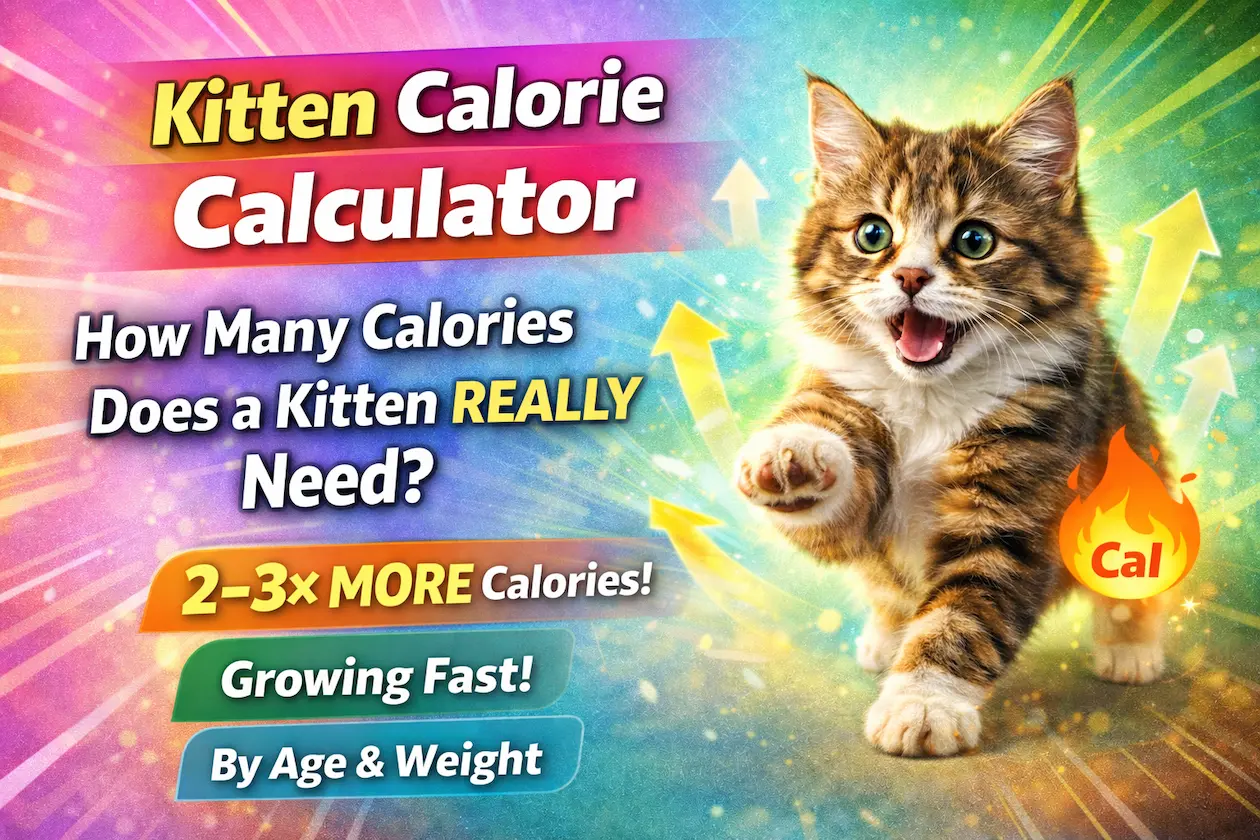
Important: Kittens need 2-3x more calories per pound than adult cats to support their rapid growth and development.
Simply fill out the fields and click Calculate to get started.
Quick Steps
1Enter your Kitten's Weight in pounds.
2Select the Activity Level of your kitten.
3Select the Neutered/Spayed Status of your kitten.
4Select the Feeding Frequency of your kitten.
5Select the Current Diet Type of your kitten.
6Click the Calculate button to see the estimated daily calorie requirement.
Kitten Calorie Calculator
Fill Out The Fields Below
Result
Feeding Frequencies for Kittens
Feeding Frequency
Description
Once a day
Not recommended for kittens. Kittens need multiple meals per day.
Twice a day
Minimum recommended for older kittens (6+ months).
Three times a day
Recommended for most kittens to ensure adequate nutrition and energy.
Four times a day
Ideal for young kittens (under 6 months) to support rapid growth.
Diet Types for Kittens
Diet Type
Description
Dry Food
Convenient and helps maintain dental health. Ensure adequate water intake for kittens.
Wet Food
Provides additional hydration and can be more palatable for picky kittens.
Combination of Dry and Wet
Balances benefits of both types, offering hydration and dental health benefits.
Neuter/Spay Status Options
Neuter/Spay Status
Description
Yes
Kittens are typically neutered/spayed around 4-6 months. Neutered kittens may need slightly fewer calories.
No
Intact kittens may have slightly higher calorie needs.
Our kitten calorie calculator helps you determine exactly how many calories your kitten needs each day for healthy growth and development. Kittens have unique nutritional requirements compared to adult cats, needing significantly more calories per pound of body weight.
How Many Calories Does a Kitten Need?
Kittens need 2-3x more calories per pound than adult cats because they're growing rapidly and are very active. However, the exact amount depends on:
Weight: Current weight (kittens grow quickly, so weigh regularly)
Age: Younger kittens need more calories per pound
Breed: Large breed kittens (like Maine Coons) may need more calories
Activity Level: Active kittens need more calories
Neuter Status: Neutered kittens may need slightly fewer calories
Kitten Feeding Guidelines
Typical calorie needs for kittens:
Kittens (2-4 months): 200-300 calories per day
Kittens (4-6 months): 250-350 calories per day
Kittens (6-12 months): 300-400 calories per day
Large breed kittens: May need up to 500 calories per day
Note: These are general guidelines. Use our calculator above for personalized recommendations based on your specific kitten.
Kitten Feeding Schedule
Kittens need more frequent meals than adult cats:
2-4 months: 4 meals per day
4-6 months: 3-4 meals per day
6-12 months: 2-3 meals per day
After 12 months: Most cats can transition to 2 meals per day
Important Kitten Nutrition Tips
Feed high-quality kitten food formulated for growth
Kittens need more protein and fat than adult cats
Monitor your kitten's weight and body condition regularly
Provide fresh water at all times
Don't free-feed - scheduled meals help prevent overeating
Consult your veterinarian for breed-specific recommendations
Kitten vs Adult Cat Calorie Needs
Our calculator uses a 2.5x multiplier for kittens compared to adult cats. This accounts for:
Rapid growth and development
High activity levels
Higher metabolic rate
Development of muscles, bones, and organs
Kitten Calorie Needs by Breed
While all kittens need more calories than adult cats, breed size affects how many calories your kitten needs and how long they continue growing. Larger breeds need more calories and grow for longer.
Breed Type
Example Breeds
Daily Calories (4-6 months)
Growth Period
Small breeds
Singapura, Devon Rex, Cornish Rex
200–280 kcal
10–12 months
Medium breeds
Siamese, Domestic Shorthair, Abyssinian
250–350 kcal
12 months
Large breeds
Maine Coon, Norwegian Forest, Ragdoll
350–500 kcal
18–24 months
Large breed kittens like Maine Coons grow slower but for longer, and need kitten-formula food for up to 24 months. Use the calculator above with your kitten's actual weight for a precise daily calorie target. For adult cat calorie needs, see our Cat Calorie Calculator.
How the Kitten Calorie Calculator Works
The calculator starts from your kitten's Resting Energy Requirement (RER), the baseline calories needed to keep the body functioning at rest. Veterinary nutritionists calculate RER with a standard formula, then apply a growth multiplier for kittens.
Step 1 — RER: RER = 70 x (body weight in kg)^0.75. A 2 kg kitten has an RER of about 117 calories.
Step 2 — Growth multiplier: Kittens under 4 months use a multiplier near 3.0, and kittens 4 to 12 months use about 2.0 to 2.5. This reflects the energy cost of building bone, muscle, and organs.
Step 3 — Adjustments: Activity level, neuter status, and diet type fine-tune the final number.
The result is your kitten's Maintenance Energy Requirement (MER), the total daily calories to support both maintenance and growth. Because kittens grow fast, recalculate every two to four weeks as their weight changes.
Example Kitten Calorie Calculations
These worked examples show how weight and age change the daily calorie target. Your calculator result may differ slightly based on activity and neuter status.
Kitten Age
Weight
Approx. RER
Daily Calorie Target
2 months
1.1 lb (0.5 kg)
~42 kcal
~125 kcal
4 months
4.4 lb (2 kg)
~117 kcal
~290 kcal
6 months
6.6 lb (3 kg)
~160 kcal
~350 kcal
10 months
8.8 lb (4 kg)
~198 kcal
~400 kcal
Enter your kitten's exact weight in the calculator above for a personalized target rather than relying on these averages.
Wet Food vs Dry Food Calories for Kittens
Kitten food comes in different calorie densities, so the same daily target can mean very different portion sizes. Understanding calorie density helps you measure meals correctly.
Dry food (kibble): Roughly 350 to 500 calories per cup. Small portions carry a lot of energy, so measure with a scoop rather than eyeballing.
Wet food (canned): Roughly 70 to 110 calories per 3 oz can. Wet food adds hydration and is easier for young kittens to chew.
Combination feeding: Many owners mix wet and dry to balance hydration, dental benefits, and cost. Count calories from both toward the daily total.
Always check the calorie content (listed as "kcal/kg" or "kcal per cup/can") printed on your specific food's label, since brands vary widely. Divide your kitten's daily calorie target by the food's calorie density to find the right portion.
Signs Your Kitten Is Eating the Right Amount
Calorie math is a starting point, but your kitten's body tells you whether the amount is right. Check these signs regularly and adjust portions as your kitten grows.
Steady weight gain: Healthy kittens gain roughly 0.5 to 1 oz per day in the early months. Consistent, gradual gain is the goal.
Body condition: You should feel the ribs with a light touch but not see them. A visible waist from above is a good sign.
Energy and play: A well-fed kitten is active, curious, and playful between naps.
Healthy coat and stool: A soft, shiny coat and firm stools indicate the diet is being digested well.
Warning signs: A pot-bellied look, sluggishness, or rapid weight gain can mean overfeeding; visible ribs and spine can mean underfeeding.
Common Kitten Feeding Mistakes to Avoid
Feeding adult cat food: Adult formulas lack the extra protein, fat, and calories a growing kitten needs. Use food labeled for kittens or "all life stages."
Free-feeding all day: Leaving food out constantly makes it hard to track intake and can lead to overeating. Use scheduled meals.
Offering cow's milk: Most kittens are lactose intolerant and cow's milk can cause diarrhea. Provide fresh water instead.
Not adjusting portions: A portion that fit last month is often too small now. Recalculate as your kitten's weight climbs.
Too many treats: Treats should stay under 10 percent of daily calories so they do not crowd out balanced nutrition.
Switching food too fast: Transition to new food over 7 to 10 days to avoid stomach upset.
Frequently Asked Questions About Kitten Calories
How many calories does a kitten need per day?
Most kittens need between 200 and 400 calories per day depending on age, weight, and breed, which is roughly 2 to 3 times the calories of an adult cat of the same weight. Use the calculator above for a number tailored to your kitten.
How much should I feed my kitten at each meal?
Divide your kitten's daily calorie target by the number of meals. A kitten needing 300 calories across 4 meals would eat about 75 calories per meal. Convert that to portion size using your food's calorie density.
When should I switch from kitten food to adult food?
Most kittens transition to adult food around 12 months. Large breeds like Maine Coons may stay on kitten food until 18 to 24 months because they keep growing. Ask your veterinarian for timing specific to your cat.
Can I overfeed a kitten?
Yes. Even though kittens need extra calories, consistently overfeeding leads to excess weight that raises the risk of obesity and joint problems later. Weigh your kitten regularly and match portions to the calculated target.
How often should I recalculate my kitten's calorie needs?
Recalculate every two to four weeks during the fast-growth period. Kittens can double their weight in a matter of weeks, so their calorie needs change quickly.
Tip: This calculator is specifically designed for kittens (0-1 year) and automatically accounts for their higher calorie needs with a 2.5x multiplier compared to adult cats.
Free download
Download the Kitten Calorie Guide
A printable one-page calorie chart by age and weight, plus a wet vs. dry feeding comparison and key milestones. Free — no spam.
Get your free PDF
Kitten Calorie Guide (By Age & Weight)
FAQs
Frequently Asked Questions
How many calories does a kitten need?
Kittens need significantly more calories per pound than adult cats due to rapid growth. Most kittens need 2-3x the calories of adult cats of the same weight. Use our calculator to get an accurate estimate based on your kitten's specific needs.
How many calories does my kitten need calculator?
Our kitten calorie calculator determines how many calories your kitten needs based on weight, breed, activity level, and neuter status. Kittens typically need 2.5x the calories of adult cats, but this varies by age and breed.
How much should I feed my kitten?
Kittens need 3-4 meals per day until about 6 months old, then 2-3 meals. The amount depends on their calorie needs, which you can calculate using our tool. Always follow your veterinarian's recommendations for your specific kitten.
Do kittens need more calories than adult cats?
Yes, kittens need 2-3x more calories per pound than adult cats because they're growing rapidly and are very active. However, overfeeding can lead to obesity, so it's important to calculate exact needs.
When should I switch from kitten food to adult food?
Most kittens can switch to adult food around 12 months old. Some large breed cats (like Maine Coons) may benefit from kitten food until 18-24 months. Consult your veterinarian for the best timing.
How often should I feed my kitten?
Kittens should be fed 3-4 times per day until about 6 months old, then 2-3 times per day. Free-feeding is not recommended as it can lead to overeating and obesity.
Free cat food carb calculator. Calculate carbohydrate content in wet and dry cat food from the guaranteed analysis label. Compare carbs on a dry matter basis. Essential for low-carb and diabetic cat diets.
Free cat food carb calculator. Calculate carbohydrate content in wet and dry cat food from the guaranteed analysis label. Compare carbs on a dry matter basis. Essential for low-carb and diabetic cat diets.
Free dog calorie calculator by breed. Find out exactly how many calories your dog needs per day by weight, breed, age, and activity level. Get instant kcal and feeding portions for Labradors, German Shepherds, Chihuahuas, and every breed in between. Try it now.