How Much Should I Feed My Dog?
There is no single answer that fits every dog. The right daily amount depends on your dog's weight, age, activity level, whether they are spayed or neutered, and the calorie density of the food in their bowl. Two dogs of the same weight can need very different portions: a working herding dog burns far more energy than a couch companion of identical size.
The calculator above estimates daily calories using your dog's weight and life stage, then converts that figure into practical serving sizes: cups of kibble, grams of food, or cans of wet food. As a starting rule of thumb, an average adult dog needs roughly 25 to 30 calories per pound of body weight each day, but puppies, highly active dogs, and pregnant or nursing dogs need considerably more. Always treat any chart or calculator as a starting point and adjust based on your dog's body condition over the following weeks.
Dog Feeding Chart by Weight
The table below shows typical daily dry-food amounts for a healthy adult dog at a moderate activity level, based on a standard kibble of about 350 to 400 calories per cup. Split the total across the number of meals you feed each day. Puppies generally eat more than these amounts and seniors often eat less.
| Dog Weight | Daily Dry Food (cups) | Approx. Daily Calories | Suggested Meals |
|---|
| 5 lbs | 1/3–1/2 cup | 140–170 cal | 2 |
| 10 lbs | 3/4 cup | 250–290 cal | 2 |
| 25 lbs | 1.5–1.75 cups | 550–650 cal | 2 |
| 50 lbs | 2.5–3 cups | 900–1,050 cal | 2 |
| 75 lbs | 3.5–4 cups | 1,250–1,450 cal | 2 |
| 100 lbs | 4.25–5 cups | 1,550–1,800 cal | 2 |
Always check the calorie count printed on your specific food bag, since dense, high-protein formulas can pack far more energy per cup. For a breakdown of calorie needs rather than volume, use our Dog Nutrition Calculator, and check whether your dog is at a healthy weight with the Dog BMI Calculator.
How to Use the Dog Feeding Calculator
Getting an accurate portion recommendation takes under a minute. Follow these steps:
- Enter your dog's weight in pounds. Weigh your dog on a scale, or step on a bathroom scale holding them and subtract your own weight for smaller dogs.
- Choose the activity level. Low suits mostly indoor or older dogs, Moderate fits a typical daily-walk routine, and High is for working dogs, athletes, and very energetic breeds.
- Select the life stage. Puppies, young adults, adults, mature adults, and seniors all have different calorie multipliers.
- Pick the body condition. If your dog is already overweight or underweight, this adjusts the target so the plan moves them toward a healthy weight.
- Set the feeding frequency and diet type. The result splits the daily total into per-meal amounts for dry, wet, or combination diets.
- Calculate. Review the recommended cups, grams, and cans, then monitor your dog's body condition over two to three weeks and fine-tune.
Puppy, Adult, and Senior Feeding Needs
Calorie needs change dramatically across a dog's life. Feeding an adult portion to a growing puppy can stunt development, while feeding a puppy portion to a senior dog quickly leads to weight gain.
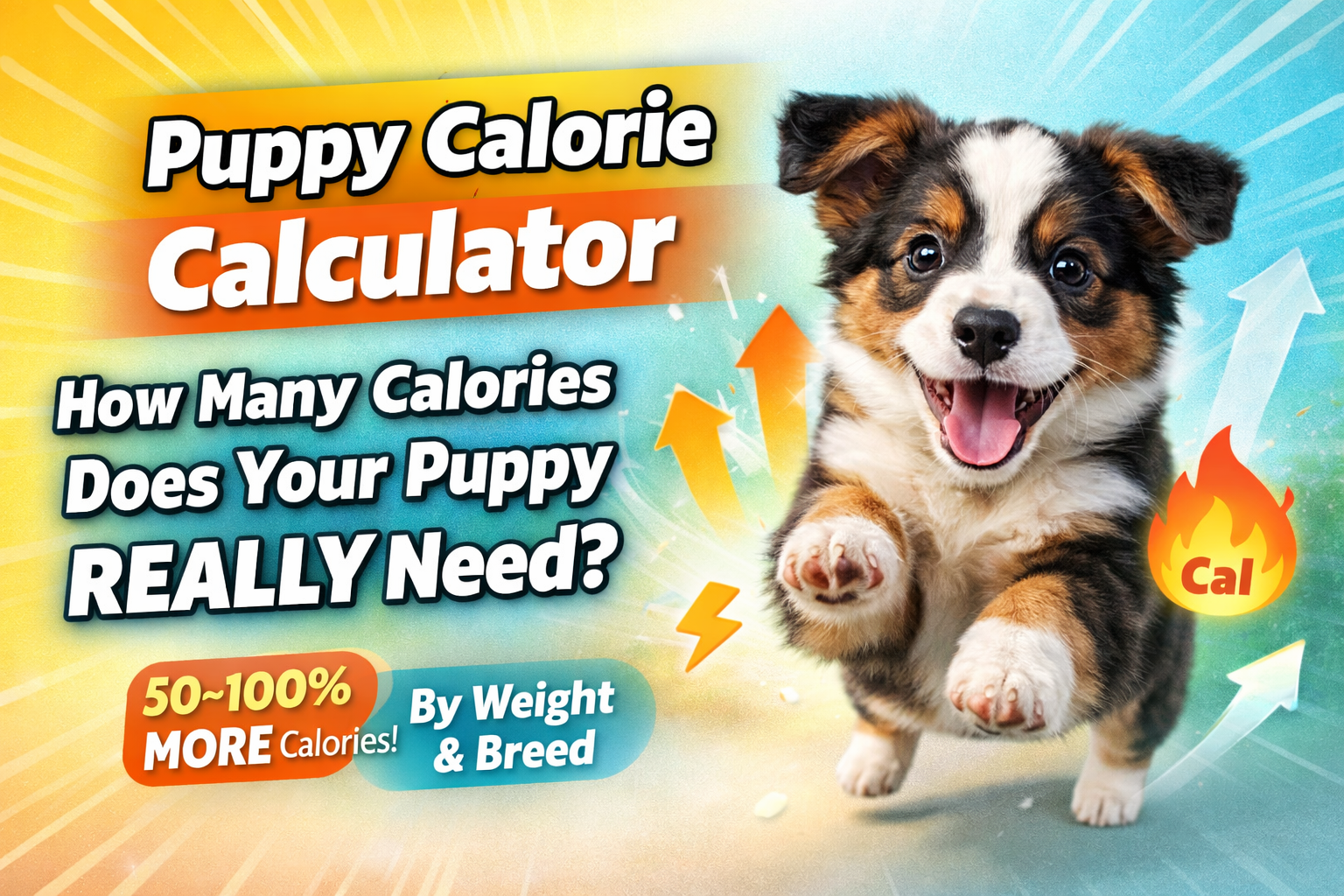
- Puppies (0–12 months): Need roughly twice the calories per pound of an adult to fuel rapid growth. Feed 3 to 4 smaller meals a day and use a food formulated for growth. Our Puppy Calorie Calculator tailors the numbers by age.
- Adults (1–7 years): Feeding stabilizes at maintenance calories. Most adult dogs thrive on two measured meals per day.
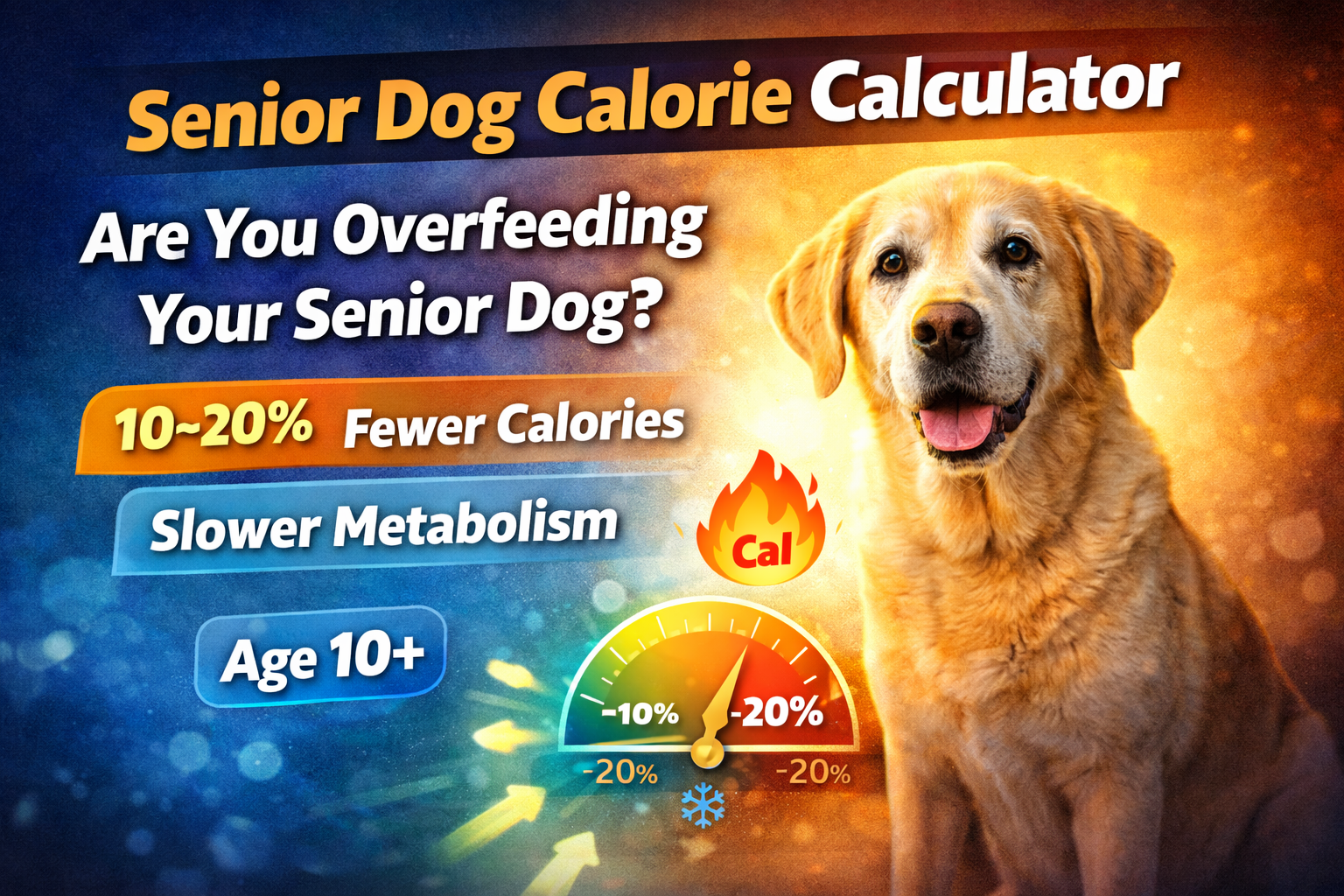
- Seniors (7+ years): Metabolism and activity typically slow, so calorie needs drop by 10 to 20 percent. Watch weight closely and consider a senior formula. See the Senior Dog Calorie Calculator.
Dry Food vs. Wet Food vs. Combination Feeding
The type of food changes how much your dog eats by volume, because wet food is mostly water and far less calorie-dense than kibble. That is why the calculator asks for diet type.
- Dry food (kibble): Calorie dense, convenient, and helps scrape plaque off teeth. A typical cup holds 350 to 400 calories, so portions are small by volume.
- Wet food: Higher moisture supports hydration and is often more palatable for picky or senior dogs, but a standard can holds far fewer calories, so dogs eat a larger volume.
- Combination feeding: Mixing kibble with a spoon of wet food balances dental benefits, hydration, and taste. Just count the calories from both sources so you do not accidentally overfeed.
Worked Example: Feeding a 50 lb Adult Dog
Consider a 4-year-old, neutered Labrador retriever weighing 50 lbs at a moderate activity level and a normal body condition. Using roughly 20 calories per pound for a typical, moderately active adult dog gives a daily target of about 1,000 calories.
- All dry food (375 cal/cup): About 2.7 cups per day, split into two meals of roughly 1.3 cups each.
- Combination: 2 cups of kibble (about 750 calories) plus a can of wet food (about 250 calories) reaches the same daily total.
- If overweight: Trimming to about 900 calories creates a gentle deficit for gradual, safe weight loss.
To burn extra energy alongside a measured diet, plan activity with the Dog Exercise Calculator, and make sure fresh water keeps pace using the Dog Water Intake Calculator.
Common Dog Feeding Mistakes to Avoid
- Free-feeding without measuring. Leaving a full bowl out all day is one of the leading causes of canine obesity. Use a measuring cup or kitchen scale for every meal.
- Forgetting treats count. Treats, chews, and table scraps should stay under 10 percent of daily calories. Subtract them from the main meals.
- Guessing the cup size. A "cup" means a level 8-ounce measuring cup, not a random mug or scoop, which can hold twice as much.
- Ignoring body condition. Charts are averages. Feel for the ribs and check for a visible waist, and adjust portions if your dog drifts above or below ideal.
- Switching foods too fast. Transition to a new food over 7 to 10 days to avoid stomach upset.
Reweigh your dog every few weeks after any change and let the calculator re-set your target as their weight and activity shift.