How Much Should My Cat Weigh?
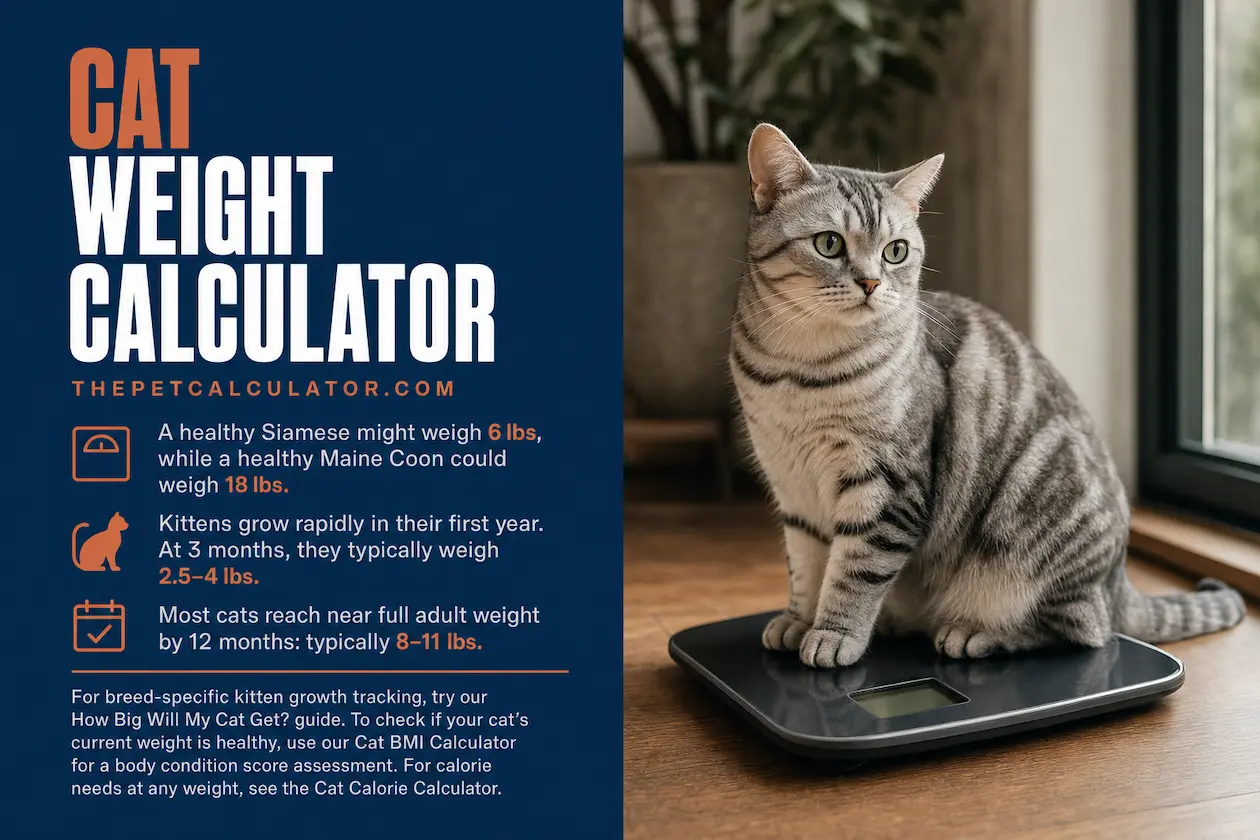
The ideal weight for a cat varies dramatically by breed. A healthy Siamese might weigh 6 lbs, while a healthy Maine Coon could be 18 lbs. Our calculator compares your cat's current weight to breed-specific standards, but here's a quick reference for common breeds:
| Breed | Female (lbs) | Male (lbs) | Adult Age |
|---|
| Domestic Shorthair | 7–10 lbs | 9–12 lbs | 12–18 months |
| Siamese | 5–8 lbs | 8–12 lbs | 12 months |
| Persian | 7–11 lbs | 9–13 lbs | 18 months |
| Maine Coon | 8–14 lbs | 13–20 lbs | 3–4 years |
| Ragdoll | 8–13 lbs | 12–18 lbs | 3–4 years |
| British Shorthair | 7–12 lbs | 12–18 lbs | 3 years |
| Bengal | 6–10 lbs | 10–16 lbs | 18 months |
| Sphynx | 6–8 lbs | 8–12 lbs | 12 months |
| Abyssinian | 6–8 lbs | 7–10 lbs | 12 months |
| Scottish Fold | 6–9 lbs | 9–13 lbs | 18 months |
Cat Weight by Age: Growth Milestones
Kittens grow rapidly in their first year. Here are typical weight milestones for an average domestic cat (individual cats and breeds may vary):
| Age | Expected Weight | Growth Notes |
|---|
| Birth | 3–4 oz | Should gain ~½ oz per day |
| 4 weeks | 0.75–1 lb | Beginning to wean, starting solid food |
| 8 weeks | 1.5–2 lbs | Fully weaned, rapid growth phase begins |
| 3 months | 2.5–4 lbs | Gaining ~1 lb per month |
| 6 months | 5–7 lbs | About 75% of adult weight. Growth slowing. |
| 12 months | 8–11 lbs | Most breeds near full adult weight |
| 18–24 months | 8–12 lbs | Full adult size for most breeds |
For breed-specific kitten growth tracking, try our How Big Will My Cat Get? guide. To check if your cat's current weight is healthy, use our Cat BMI Calculator for a body condition score assessment. For calorie needs at any weight, see the Cat Calorie Calculator.
How to Use the Cat Weight Calculator
Getting an accurate reading takes less than a minute. Follow these steps for the most reliable result:
- Weigh your cat. Step on a bathroom scale holding your cat, then subtract your own weight. For small kittens, a kitchen scale gives a more precise reading in ounces.
- Enter the weight in pounds. Convert from kilograms if needed (1 kg = 2.2 lbs). Weigh at the same time of day, ideally before a meal, for consistency.
- Select the breed. Choose the breed that best matches your cat. For mixed breeds, pick the closest match by body size and build, or use Domestic Shorthair as a general baseline.
- Review the assessment. The calculator compares your cat's weight to the ideal range and flags whether they are underweight, ideal, or overweight.
Weight alone does not tell the whole story. Pair the result with a hands-on body condition assessment for the clearest picture of your cat's health.
Body Condition Score: A Better Measure Than Weight Alone
Because frame size varies so much between cats, veterinarians rely on the Body Condition Score (BCS), a 1 to 9 scale that assesses fat coverage by feel and sight. A score of 4 to 5 is ideal. You can check your own cat at home:
- Ribs: You should feel the ribs easily with a light layer of fat over them, like the back of your hand. If you cannot feel them, your cat is likely overweight.
- Waist: Looking down from above, there should be a visible waist behind the ribs. A straight or bulging outline suggests excess weight.
- Abdomen: Viewed from the side, the belly should tuck up slightly, not hang down. A pronounced primordial pouch is normal and not the same as fat.
For a guided walkthrough with scoring, use our Cat BMI Calculator, which translates these visual and tactile checks into a clear body condition result.
Why Cat Weight Matters for Health
An estimated 60% of cats in the United States are overweight or obese, making it the most common preventable health problem in cats. Even a couple of extra pounds is significant on a cat's small frame, roughly the equivalent of 30 or more excess pounds on a person.
Carrying extra weight raises the risk of several serious conditions:
- Type 2 diabetes: Overweight cats are up to four times more likely to develop diabetes.
- Arthritis and joint stress: Extra weight accelerates cartilage wear, especially in the hips and knees.
- Hepatic lipidosis (fatty liver): A dangerous condition that can develop quickly if an overweight cat stops eating.
- Urinary and heart problems: Obesity is linked to lower urinary tract disease and reduced cardiovascular fitness.
Underweight cats carry their own risks, from weakened immunity to signs of underlying illness. Keeping your cat within its ideal range is one of the most effective ways to extend both lifespan and quality of life.
Indoor vs. Outdoor Cats: Does Lifestyle Change Ideal Weight?
The ideal weight range for a breed does not change based on lifestyle, but the risk of drifting outside it does. Indoor cats are far more prone to weight gain because they burn fewer calories and often have unrestricted access to food.
If your cat lives primarily indoors, these habits help keep weight in the healthy range:
- Measure meals with a proper scoop or scale instead of free-feeding a full bowl.
- Use puzzle feeders and food-dispensing toys to add activity to mealtime.
- Schedule two or three short play sessions a day to mimic natural hunting bursts.
- Choose a diet matched to activity level. Our Cat Calorie Calculator estimates daily needs for indoor and active cats.
Outdoor and working cats generally burn more energy, but they also face variable food access, so regular weigh-ins remain the best way to catch changes early.
Worked Example: Is a 14 lb Cat Overweight?
Imagine a 3-year-old male cat weighing 14 lbs. Whether that number is healthy depends entirely on breed:
- Domestic Shorthair (ideal 9–12 lbs): At 14 lbs, this cat is roughly 2 lbs over the top of its range, placing it in the overweight category. A weight loss plan is warranted.
- Maine Coon (ideal 13–20 lbs): At 14 lbs, this cat sits comfortably within the ideal range and is a perfectly healthy size.
- Ragdoll (ideal 12–18 lbs): At 14 lbs, this cat is right in the middle of its expected range.
This is exactly why a single weight number can be misleading, and why the calculator adjusts the assessment by breed. If your cat is over its range, our Cat Weight Loss Calculator builds a safe, gradual plan to reach target weight.
Frequently Asked Questions
What is an ideal weight range for cats?
Ideal weight ranges vary significantly by breed. Each breed has natural size variations, so ideal weight is expressed as a range rather than a single number. Our calculator uses breed-specific standards to provide accurate weight ranges.
How do I know if my cat is at a healthy weight?
Compare your cat's current weight to the ideal weight range for their breed using our calculator. You can also use our Cat BMI Calculator to assess body condition, as Body Condition Score (BCS) is often more reliable than weight alone.
What should I do if my cat is underweight?
If your cat is underweight, consult your veterinarian immediately. Underweight cats may have underlying health issues that need to be addressed. A veterinarian can help create a safe weight gain plan and rule out medical causes.
What should I do if my cat is overweight?
If your cat is overweight, consult your veterinarian for a weight loss plan. They may recommend a calorie-restricted diet and increased exercise. You can also use our Cat Weight Loss Calculator to create a personalized weight loss plan.
My cat is a mixed breed. Which breed should I select?
For mixed breed cats, select the breed that most closely matches your cat's size and build. If unsure, consult your veterinarian. Body Condition Score (BCS) assessment may be more helpful than breed-specific weight ranges for mixed breeds.
How does this differ from a BMI calculator?
A weight calculator compares your cat's weight to breed standards, while a BMI calculator assesses body condition using visual and tactile assessment (Body Condition Score). Both tools provide valuable information, and using them together gives the most complete picture of your cat's health.
How much should a domestic shorthair cat weigh?
A healthy domestic shorthair typically weighs 8–11 lbs (3.5–5 kg). Males tend to be heavier (9–12 lbs) than females (7–10 lbs). However, body frame size varies, so a body condition score assessment alongside weight gives a more complete picture.
At what age is a cat fully grown?
Most cats reach their full adult weight by 12–18 months. However, larger breeds like Maine Coons may continue growing until 3–4 years old. Siamese and other Oriental breeds typically reach full size by 12 months. Use breed-specific growth charts for the most accurate expectation.
How often should I weigh my cat?
Weigh your cat monthly for routine health monitoring, or weekly if they're on a weight loss or gain program. Use the same scale at the same time of day for consistency. A change of more than 0.5 lb in a month warrants a vet visit.
Why is my cat losing weight but still eating?
Weight loss despite normal appetite can indicate hyperthyroidism, diabetes, kidney disease, intestinal parasites, or dental pain. This is especially common in cats over 10 years old. If your cat is losing weight while eating normally, consult your veterinarian promptly.