Why Tracking Kitten Weight Matters
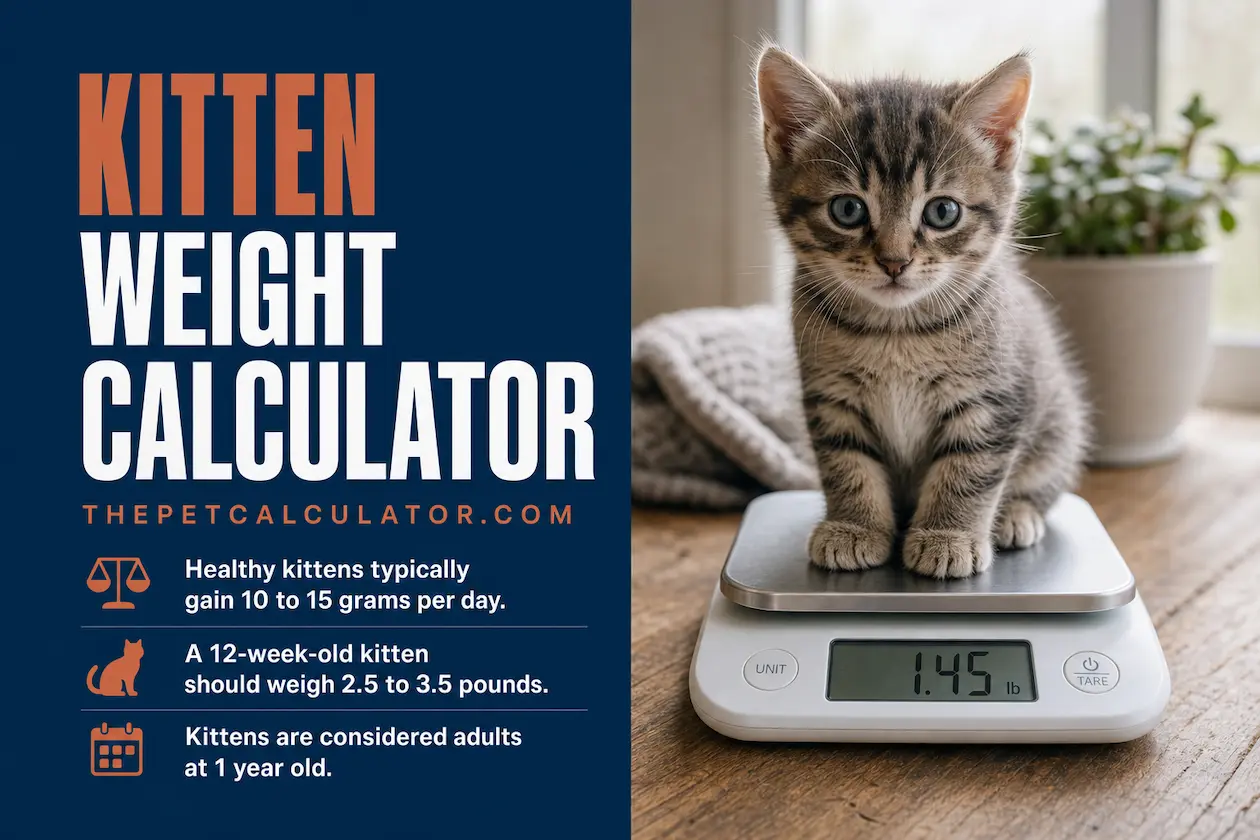
Weight is the single most reliable way to confirm that a kitten is growing normally. During the first few months of life, kittens develop faster than at any other stage, and their weight should climb steadily week after week. A healthy kitten typically gains roughly 100 grams, about a quarter of a pound, each week, so a scale that stalls or drops is often the earliest sign that something needs attention, well before behavior changes become obvious.
Our kitten weight calculator compares your kitten's current weight to the expected range for its age and helps you see at a glance whether it is on track, underweight, or heavier than expected. Because kittens grow at slightly different rates depending on breed, sex, and litter size, the calculator gives a healthy range rather than a single target number, which is a far more realistic way to judge growth.
Expected Kitten Weight by Age
The table below shows typical weight ranges for kittens from birth through about six months. These are general references for average domestic kittens; larger breeds such as Maine Coons will sit at the top of each range or above it, while small or premature kittens may start lower and catch up over time. Use these figures alongside your calculator result rather than as strict targets.
| Age | Typical Weight | Milestone |
|---|
| Newborn | 3–4 oz (85–115 g) | Eyes closed, nursing only |
| 1 week | 6–8 oz (170–230 g) | Weight should roughly double |
| 2 weeks | 8–12 oz (230–340 g) | Eyes open, starting to stand |
| 4 weeks | 0.75–1 lb (340–450 g) | Weaning begins |
| 8 weeks | 1.5–2 lb (680–900 g) | Ready for first vaccines |
| 12 weeks | 2.5–4 lb (1.1–1.8 kg) | Fully weaned, active play |
| 6 months | 5–8 lb (2.3–3.6 kg) | Approaching adult size |
How to Weigh Your Kitten Accurately
Consistent weighing is the foundation of useful tracking. A digital kitchen scale that reads in grams or ounces is ideal for young kittens, because it is precise enough to catch the small weekly gains that matter most in the first eight weeks. Older, larger kittens can be weighed on a baby scale or by weighing yourself while holding them and subtracting your own weight.
- Use a container: Place a small bowl, basket, or towel on the scale, tare it to zero, then set the kitten inside so it stays still and safe.
- Weigh at the same time: Aim for the same time of day, ideally before a feeding, so a full stomach does not skew the reading.
- Weigh in grams for accuracy: Grams give the resolution needed to notice small trends in tiny kittens where a few grams is meaningful.
- Log every reading: Keep a simple weight log with dates so you can watch the growth curve rather than reacting to a single number.
Signs of an Underweight or Overweight Kitten
The scale gives you the number, but a quick physical check tells you what it means. An underweight kitten often feels bony, with ribs, spine, and hip bones that are easy to see or feel, a tucked belly, and low energy or a poor appetite. Failure to gain weight from one week to the next is the clearest warning sign in a nursing kitten and warrants a same-day call to your veterinarian.
Overweight is less common in very young kittens but can appear after weaning if free feeding is not managed. A kitten carrying too much weight will have ribs that are hard to feel under a layer of fat, a rounded belly, and less interest in play. Because kittens still need generous nutrition to grow, never restrict food to slim a kitten down without veterinary guidance; the goal is steady, healthy growth, not weight loss.
Factors That Affect Kitten Growth
Kittens grow at different rates, and understanding the drivers helps you interpret the numbers rather than just record them:
- Breed: Large breeds such as Maine Coons and Ragdolls grow more slowly and reach a much higher adult weight, while smaller breeds finish sooner and lighter.
- Sex: Male kittens usually grow faster and end up heavier than females of the same breed and litter.
- Nutrition: A complete, kitten-formulated diet with adequate protein and calories drives steady growth; poor diet or early weaning can slow it.
- Litter size and birth weight: Kittens from large litters or born small may start behind and then catch up over the first few months.
- Health and parasites: Intestinal worms, infections, and congenital issues can stall growth, which is why unexplained weight changes deserve a vet visit.
- Weaning transition: The shift from mother's milk to solid food around four weeks can cause a brief plateau before growth resumes.
Predicting Your Kitten's Adult Weight
Many owners want to know how big their kitten will become. A common rule of thumb is that a kitten's weight at 16 weeks is roughly half its expected adult weight, so a four-month-old kitten weighing 4 pounds may mature to around 8 pounds. Another simple estimate for average domestic cats is that adult weight is often about twice the weight at four months of age.
These estimates work best for typical domestic shorthairs and become less reliable for large or unusual breeds. A Maine Coon may keep growing for up to three or four years and reach 12 to 18 pounds, far beyond what an early estimate would suggest. Treat any adult prediction as a general range to expect rather than a fixed figure, and remember that genetics and neutering timing both influence final size.
Example: Assessing an 8-Week-Old Kitten
Suppose you adopt an eight-week-old domestic shorthair kitten weighing 1.8 pounds. Entering that age and weight into the calculator places her comfortably within the expected 1.5 to 2 pound range for eight weeks, so no concern is flagged. You confirm this by touch: her ribs are covered but easy to feel, she has a slight belly after meals, and she is active and playful.
Over the next four weeks you weigh her each week and watch her climb to 2.1, 2.5, 2.9, and finally 3.2 pounds, a healthy gain of roughly a quarter pound per week. Because you tracked the trend rather than a single reading, you can see the growth curve is on track. If instead the weekly numbers had stalled or dropped, that early signal would prompt a vet visit long before she looked visibly unwell.
Kitten Weight vs. Body Condition
A number on the scale is only half the picture. Two kittens of the same age can share the same weight yet be in very different condition if one has a larger frame or more muscle than the other. That is why veterinarians pair weight with a body condition check, judging fat cover and proportions by gently feeling the ribs, spine, and waist.
Use the calculator's weight range as a quick screening tool, then confirm with a hands-on body condition check. If the weight sits in range but the kitten looks thin or feels bony, trust the physical assessment and talk to your vet. As your kitten matures, explore our full library of pet weight calculators and pet health calculators to keep monitoring healthy growth.
Frequently Asked Questions About Kitten Weight
How often should I weigh my kitten?
Kittens should be weighed weekly during their first few months to monitor growth. Healthy kittens should gain weight steadily. If your kitten is losing weight or not gaining, consult your veterinarian immediately.
What if my kitten is underweight?
If your kitten is underweight, consult your veterinarian. Underweight kittens may have health issues, parasites, or feeding problems that need to be addressed. Your vet can help create a plan for healthy weight gain.
What if my kitten is overweight?
Overweight kittens may be at risk for health problems. However, kittens need adequate nutrition for growth. Consult your veterinarian before restricting food, as they can help ensure your kitten gets proper nutrition while maintaining a healthy weight.
How accurate are adult weight predictions?
Adult weight predictions are estimates based on growth curves. Individual kittens may vary based on genetics, breed, and nutrition. These estimates provide a general range to expect.